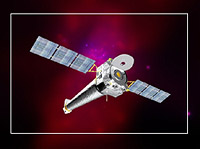
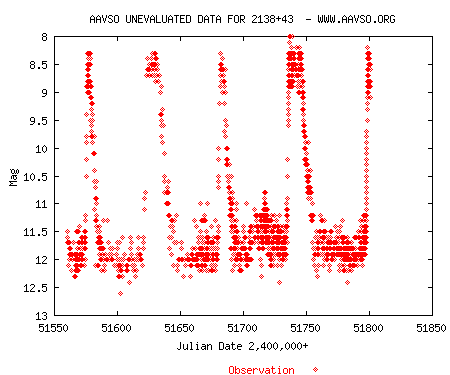
The start of the SS Cygni outburst was discovered in its very early stage over the weekend by tens of amateur astronomers who have been "keeping a vigil" to "catch" the outburst. It was then
confirmed by other amateurs, many of whom are members of the AAVSO. They e-mailed or phoned-in their observations to the AAVSO. Dr. Mattei communicated this information to Dr. Mauche and advised him
to submit the request to start the X-ray observations. Within hours of Dr. Mauche's request on a Sunday, he was speaking with Dr. Fred Seward and Dr. Pat Slane of the Chandra team on the specifics of
the requested observations. Thanks to their and other Chandra team's efforts, Chandra observations began on Sept. 12.7 UT and will continue until Sept. 14.5 (Sept 12.7 UT is Sept 12, 16:48 UT or
Sept. 12, 12:48 EDT or in Julian Date - 2451800.2).
Dr. Mauche also spoke with Marty Eckert, the EUVE Science Planner, on Sunday to arrange for simultaneous observations of SS Cygni with NASA's EUVE satellite. EUVE measures the brightness and spectra in the extreme ultraviolet, providing unique information about the very short (10 sec) quasi-period oscillations that
appear only during outburst in SS Cygni.
This is a wonderful collaboration of amateur and professional astronomers and NASA's pioneering satellites.
The AAVSO was founded in 1911 at Harvard College Observatory to coordinate variable star observations made largely by amateur astronomers and became an independent, non-profit organization in 1954.
Today, the AAVSO has members in over 40 countries and maintains the world's largest computer- readable variable star data archive, with nearly 10 million observations, and growing by almost half a
million yearly. The AAVSO is headquartered in Cambridge, Massachusetts.
For more information, refer to the AAVSO website at http://www.aavso.org.
Return to Chandra Chronicles
Highlights and Feature Stories from the Chandra Project
Archived reports of past Chandra Chronicles
Receive the Chandra Digest
Updated: March 27, 2008