An overview of the Chandra mission and goals, Chandra's namesake, top 10 facts.
Classroom activities, printable materials, interactive games & more.
Overview of X-ray Astronomy and X-ray sources: black holes to galaxy clusters.
All Chandra images released to the public listed by date & by category
Current Chandra press releases, status reports, interviews & biographies.
A collection of multimedia, illustrations & animations, a glossary, FAQ & more.
A collection of illustrations, animations and video.
Chandra discoveries in an audio/video format.
Disclaimer: This material is being kept online for historical purposes. Though accurate at the time of publication, it is no longer being updated. The page may contain broken links or outdated information, and parts may not function in current web browsers. Visit chandra.si.edu for current information.
Chandra's First Year
August 22, 2000 ::
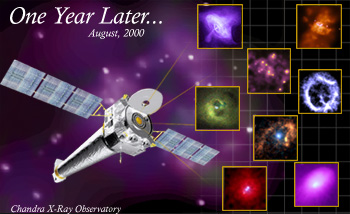
Chandra: 1999-2000 Pictorial Overview (quicktime) |
On August 12, 2000, NASA's Chandra X-ray Observatory completed an outstanding first full year of observations. About 450 sources were observed, ranging
from
Comet LINEAR (1999 S4) in our solar system, to cosmic objects ten billion light years away.
Astronomers were frequently surprised and often confounded by what Chandra revealed. The
first flare ever
observed from a brown dwarf was imaged, as was a
brilliant X-ray jet emanating from a supergiant black hole and extending over half a million light
years. Chandra resolved most of the luminous
X-ray background glow into individual sources believed to be black holes in the centers of galaxies.
Its power and sensitivity captured the image of a small galaxy in the process of being
cannibalized by a large one. The observatory located and measured vast
clouds of oxygen, calcium and iron in the multi-million degree remains of supernovas, thus shedding light on how these
vital elements are produced and
dispersed.

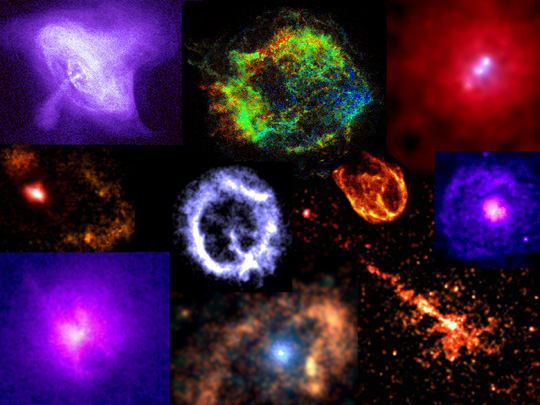
A collection of images made by the Chandra X-Ray Observatory.
|
"It has been a fantastic first year with Chandra. We have met or exceeded all of our goals." - Gordon Garmire, of Penn State Univ., Principal Investigator for ACIS.
As data keeps flooding in and new observations are planned, astronomers and the community at large eagerly await next year's revelations.
Disclaimer: This material is being kept online for historical purposes. Though accurate at the time of publication, it is no longer being updated. The page may contain broken links or outdated information, and parts may not function in current web browsers. Visit chandra.si.edu for current information.