The Journey Continues

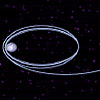
Chandra orbit path
Artist's conception of Chandra's orbit path.
View the Quick Time Movies of Deployment & Orbit.
Illustration: NGST
July 25, 1999 - Cambridge, MA :: NASA's Chandra X-ray Observatory's ascent to its final orbit began Saturday night with the first of five planned firings of the liquid rocket engines of Chandra's internal propulsion system. The hydrazine fueled rocket burn lasted for about five minutes. The burn occurred on schedule at 9:11 p.m. EDT. During the five minute burn, scientists, managers and members of the flight operations team hovered over the consoles, poring over the data as it flashed onto the screens.

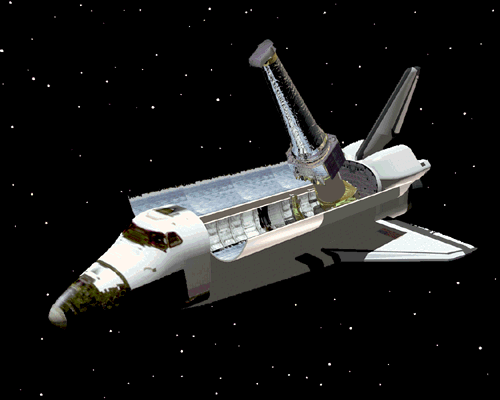
Columbia deploying Chandra
Artist's conception of Shuttle deploying Chandra.
Illustration: NGST
Cheers, applause and high fives greeted the announcement that "Everything is nominal," by Jean Oliver, deputy program manager from NASA's Marshall Space Flight Center.

The rocket firing took Chandra to an orbit that is 750 miles (1200 km) above Earth at closest approach (perigee) and 45,000 miles (72,000 km) at its most distant point (apogee). In this orbit, Chandra will take a little over 24 hours to make one complete trip around the Earth.


Recent Headlines
The next of four more rocket firings is scheduled for tonight around ten o'clock.. When the entire sequence is completed about ten days from now, Chandra will have a perigee of about 6,200 miles and an apogee of 87,000 miles. In this orbit, the observatory will be outside the radiation belts that surround the Earth for over eighty percent of the time, allowing for 55 hours of uninterrupted observations during each orbit.

At a briefing this morning, Oliver, Roger Brissenden, manager of the Chandra Operations and Control Center, and Craig Staresinich, of TRW (now NGST) reported that the initial checkout of all other systems on the observatory indicated that they are operating properly.

"It just keeps getting better," Staresinich said.

"Four burns to go and four doors to open," announced Max Rosenthal of Marshall Space Flight Center. Stay tuned.


NASA TV Watch the launch!!!
NASA TV viewing options (on the web and on television!) of STS-93, Chandra X-ray Observatory.
The NASA TV Schedule for launch is also available.


Return to Chandra Chronicles

Highlights and Feature Stories from the Chandra Project
Archived reports of past Chandra Chronicles
Receive the Chandra Digest
Updated: March 27, 2008