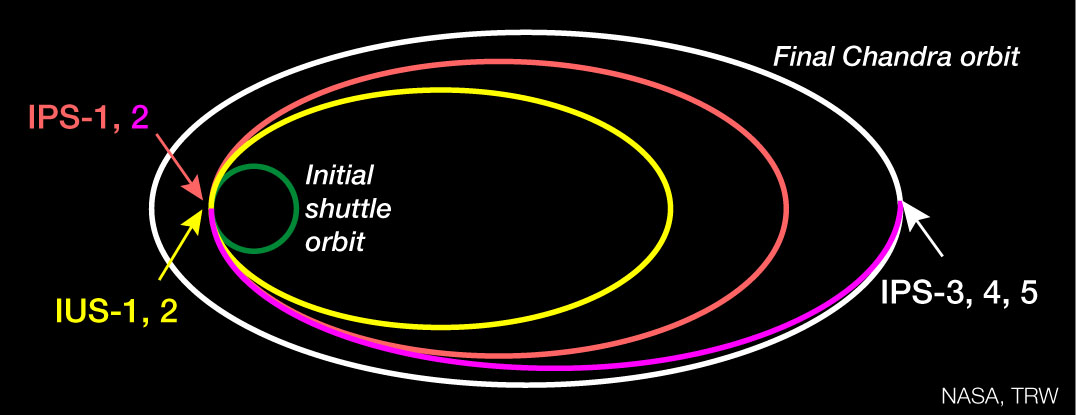
Chandra managers had decided, after reviewing the performance of the third IPS burn to switch to the back-up engines. There were some faulty temperature sensors on the original pair and one of the engines was not performing quite up to
par. Although there was some feeling that they should continue to use the engines that had already been proven, it was ultimately considered prudent to go with the new, redundant engines. The choice proved to be a good one.
"It's great to have that one out of the way," said Roger Brissenden, Chandra Center manager. "I didn't expect anything to go wrong, but you never know. We were using different engines with different flow rates and different thrusts."
The burn raised Chandra's perigee (closest approach to Earth) to 3,535 miles (5,689 kilometers) and left the apogee, or high point essentially unchanged at 86,448 miles (139,125 kilometers). Now the observatory is set for its next firing on Saturday,
August 6 which should raise Chandra's orbit to its planned perigee.
Return to Chandra Chronicles
Highlights and Feature Stories from the Chandra Project
Archived reports of past Chandra Chronicles
Receive the Chandra Digest
Updated: March 27, 2008