

What's a specific instance where Chandra will be useful?
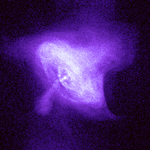
The Crab Nebula is an expanding cloud of gas leftover from a supernova explosion. Compare a Chandra X-ray image (Left) and an Optical image (Right) below.
| 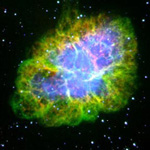 |
Photo Credits: X-ray: NASA/CXC/SAO; Optical: Palomar Obs. | |
The X-ray nebula shown in the Chandra image is about 40% as large as the optical nebula. The X rays are more concentrated toward the center than the optical emission. Also, it seems that the X-ray image is NOT centered on the pulsar, the star remnant from the supernova. There are all sorts of interesting loops and knots in the X-ray image, some of which appear to correlate with optical features and some that do not.
Do these x-ray features change over time, as do the images in the visible wavelengths? And how fast are these knots moving? Perhaps future observations with Chandra will provide the answer. With its incomparably better imaging capabilities, we may some day be able to see the shock waves made by the pulsar as it feeds energy into the Nebula.




Revised: September 11, 2008