


CXC Home | Search | Help | Image Use Policy | Latest Images | Privacy | Accessibility | Glossary | Q&A
Brown Dwarfs & Low Mass Stars:
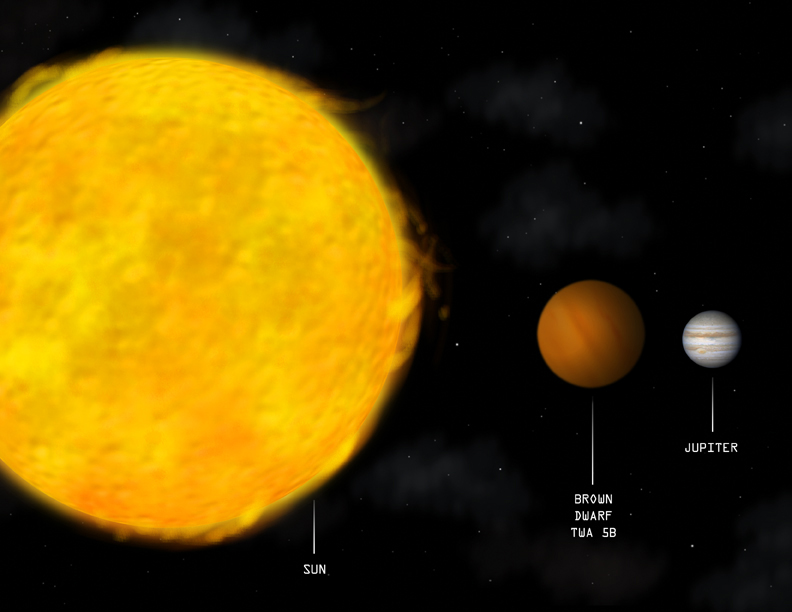
If a protostar forms with a mass less than 0.08 solar masses, its internal temperature never becomes high enough for thermonuclear fusion to begin. This “failed” star is called a brown dwarf, halfway between a planet (like Jupiter) and a star. A star shines because of the thermonuclear reactions in its core, which release enormous amounts of energy by fusing hydrogen into helium. For the fusion reactions to occur, though, the temperature in the star's core must reach at least three million K. Because core temperature rises with gravitational pressure, the star must have a minimum mass: about 75 times the mass of the planet Jupiter, or approximately 8 percent of the mass of the Sun. A brown dwarf does not have enough mass; it is heavier than a gas giant planet but not quite massive enough to be a star. Brown dwarfs still emit energy, mostly in the infrared, due to the potential energy of collapse converted into kinetic energy. There is enough energy from the collapse to cause the brown dwarf to shine for more than ~15 million years. Brown dwarfs eventual radiate all their heat into space. The composite Hubble image shows the bright Trapezium stars (optical) within the Orion Nebula combined with an infrared image that shows a swarm of brown dwarfs.
All through the long life of a low mass star, the relentless compression of gravity is balanced by the outward pressure from the nuclear fusion reactions in the core. Eventually, the hydrogen nuclei in the core is all converted to helium nuclei and the nuclear reactions stop. No further evolution takes place in stars with less than 0.8 solar masses. The time it takes for low mass stars to use up all their hydrogen fuel is longer than the current age of the universe (about 14 billion years). These extremely low mass stars are called red dwarfs, and they are located on the lower right corner of the main sequence on the H-R Diagram. Proxima Centauri, the nearest star to the Sun, is a red dwarf star.


Revised: July 03, 2012