

1
M82
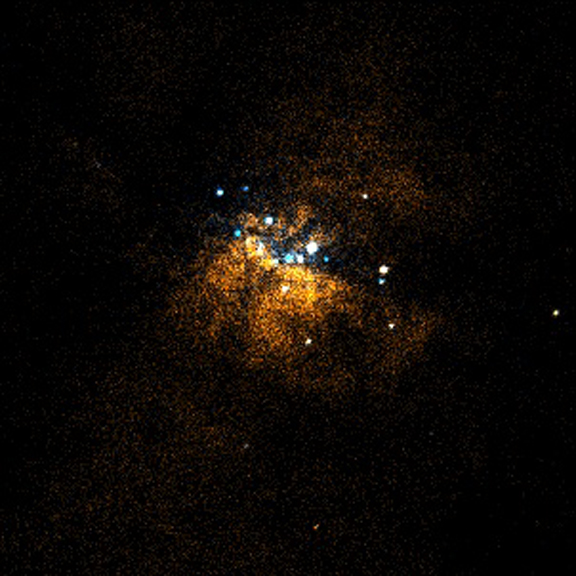
This image shows the X-ray emission in colors that give an indication of the energy of the X-rays. The X-rays are more energetic as the colors go from red to blue. The bright spots are supernova remnants and X-ray binaries. Most are likely to be X-ray binaries, and the blue ones are certainly X-ray binaries. These are some of the brightest supernovas and X-ray binaries known, and the luminosity of X-ray binaries suggests that most are black hole candidates. The orange, diffuse emission is hot gas at temperatures of around 10 million degrees Celsius. The size of the image is 2.5 kpc by 2.5 kpc.
(Credit: NASA/PSU/CMU)
This image shows the X-ray emission in colors that give an indication of the energy of the X-rays. The X-rays are more energetic as the colors go from red to blue. The bright spots are supernova remnants and X-ray binaries. Most are likely to be X-ray binaries, and the blue ones are certainly X-ray binaries. These are some of the brightest supernovas and X-ray binaries known, and the luminosity of X-ray binaries suggests that most are black hole candidates. The orange, diffuse emission is hot gas at temperatures of around 10 million degrees Celsius. The size of the image is 2.5 kpc by 2.5 kpc.
(Credit: NASA/PSU/CMU)
2

M82, Chandra X-ray
This image is based on the same data as image 1 but is bigger (5.0 kpc by 5.0 kpc) and has been smoothed to show the diffuse emission more clearly. Here it can be that in addition warm (10 million degree Celsius) gas flowing out of M82 (displayed in red), there is some very hot emission (100 million degree Celsius) gas in the nucleus (displayed in blue).
(Credit: NASA/PSU/CMU)
This image is based on the same data as image 1 but is bigger (5.0 kpc by 5.0 kpc) and has been smoothed to show the diffuse emission more clearly. Here it can be that in addition warm (10 million degree Celsius) gas flowing out of M82 (displayed in red), there is some very hot emission (100 million degree Celsius) gas in the nucleus (displayed in blue).
(Credit: NASA/PSU/CMU)

Return to M82 (14 Jan 00)




Revised: July 07, 2008