

Download Image


More Information


More Images
Galactic Center (Survey) Multiwavelength Image

(Credit: X-ray: NASA/UMass/
D.Wang et al., Radio: NRAO/AUI/NSF/NRL/
N.Kassim, Mid-Infrared: MSX)
D.Wang et al., Radio: NRAO/AUI/NSF/NRL/
N.Kassim, Mid-Infrared: MSX)

Animation & Video

More Releases


Related Images


Galactic Center:
Chandra Takes In The Bright Lights, Big City Of The Milky Way
Credit: NASA/UMass/D.Wang et al.


Chandra Takes In The Bright Lights, Big City Of The Milky Way
Credit: NASA/UMass/D.Wang et al.
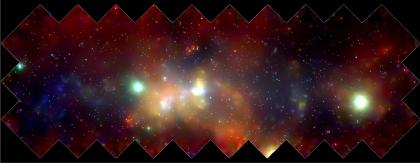
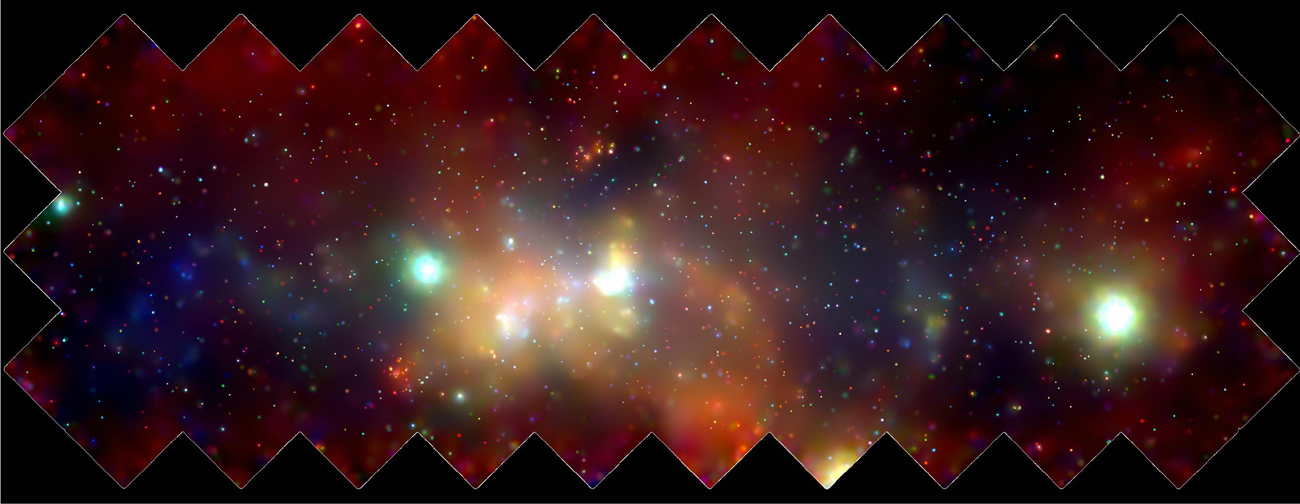
This 400 by 900 light-year mosaic of several Chandra images of the central region of our Milky Way galaxy reveals hundreds of white dwarf stars, neutron stars, and black holes bathed in an incandescent fog of multimillion-degree gas. The supermassive black hole at the center of the Galaxy is located inside the bright white patch in the center of the image. The colors indicate X-ray energy bands - red (low), green (medium), and blue (high).
The mosaic gives a new perspective on how the turbulent Galactic Center region affects the evolution of the Galaxy as a whole. This hot gas appears to be escaping from the center into the rest of the Galaxy. The outflow of gas, chemically enriched from the frequent destruction of stars, will distribute these elements into the galactic suburbs. Because it is only about 26,000 light years from Earth, the center of our Galaxy provides an excellent laboratory to learn about the cores of other galaxies.
|
||||||||||||||||||||||||||||


Revised: June 04, 2022