





CXC Home | Search | Help | Image Use Policy | Latest Images | Privacy | Accessibility | Glossary | Q&A
Download Image
More Information
More Images
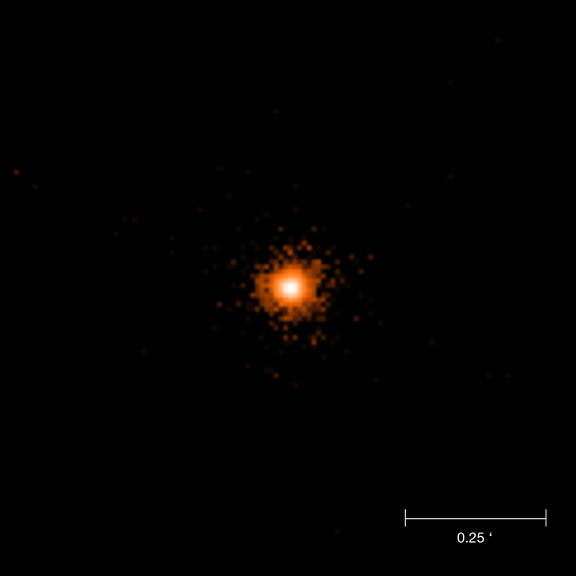
Chandra X-ray Image with Scale Bar Scalebar = .25 arcmin
(Credit: NASA/CXC.)
Related Images


Beta Ceti:
Giant Star's Corona Brightens with Age

Giant Star's Corona Brightens with Age
Beta Ceti is a bright, giant star with a hot corona that radiates about 2,000 times more X-ray power than the Sun. Scientists suspect that this X-ray activity is somehow related to its advanced stage of evolution called core helium burning. During this stage, the core of the star is very hot (more than a hundred million degrees Celsius) and converting helium to carbon via nuclear fusion reactions.
Using the theory of how stars evolve, we can reconstruct the history of Beta Ceti, a star with a mass of about 3 Suns. Over the first billion years of its existence, Beta Ceti was powered by nuclear fusion reactions converting hydrogen to helium in the core.
After the hydrogen in the core was exhausted, the central region of the star contracted until hydrogen gas around the helium core became hot and dense enough for hydrogen fusion reactions to ignite there. This powerful new energy source caused the outer regions of the star to expand greatly and cool. At this point Beta Ceti became a red giant. During the red giant phase, Beta Ceti would have been a very weak X-ray source.
After about 10 million years, the core of the star contracted and heated to more than 100 million degrees, enabling helium fusion reactions to occur there. In this core helium burning stage, which will last 100 million years or more, the overall diameter of the star has shrunk to about 20 times that of the Sun and the surface temperature has increased, so it is no longer a red giant star.
|
||||||||||||||||||||||||||
Visual Description:
This is a Chandra X-ray Observatory image featuring the giant star Beta Ceti. The dominant colors in the image are orange and white for the star, centered on a large solid black background. The shape of the X-ray data of the star is irregularly circular and blobby, with a small white source in the center. Beta Ceti is a bright, giant star with a hot corona that radiates about 2,000 times more X-ray power than the Sun. Scientists suspect that this X-ray activity is somehow related to its advanced stage of evolution called core helium burning. During this stage, the core of the star is very hot (more than a hundred million degrees Celsius) and converting helium to carbon via nuclear fusion reactions.


Revised: September 08, 2025