Chandra X-ray Observatory - HomeAbout The ChandraEducational MaterialsField GuidePhoto AlbumPress RoomResources
Chandra X-ray Observatory - HomeChandra Photo Album - You are here
ObservatoryImages by DateImages by CategorySky MapConstellationsSpecial FeaturesChandra Zoom-insImage HandoutsScale Bar ImagesTutorial Chandra Images & False Color Note on Cosmic DistanceCosmic Look Back TimeScale & DistanceScale & Angular MeasurementImage Use
Web Site ToolsVisit the Chandra ChroniclesEmail NewsletterSite MapNew & NoteworthyImage Use PolicyQuestions & AnswersGlossaryDownload Guide

Cartwheel Galaxy: Astronomers Do Flips Over Cartwheel Galaxy
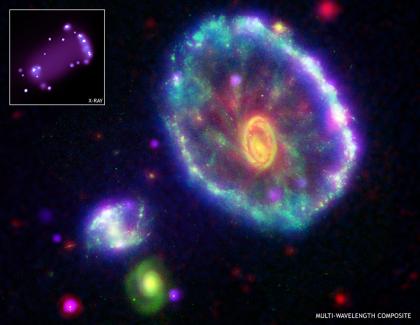
Cartwheel Galaxy
Credit: Composite: NASA/JPL/Caltech/P.Appleton et al. X-ray: NASA/CXC/A.Wolter & G.Trinchieri et al.

JPEG (480.5 kb) Tiff (8 MB) PS (2.8 MB)

This image combines data from four different observatories: the Chandra X-ray Observatory (purple); the Galaxy Evolution Explorer satellite (ultraviolet/blue); the Hubble Space Telescope (visible/green); the Spitzer Space Telescope (infrared/red). The unusual shape of the Cartwheel Galaxy is likely due to a collision with one of the smaller galaxies on the lower left several hundred million years ago.

The smaller galaxy produced compression waves in the gas of the Cartwheel as it plunged through it. These compression waves trigger bursts of star formation. The most recent star burst has lit up the Cartwheel's rim, which has a diameter larger than that of the Milky Way galaxy, with millions of bright young stars.

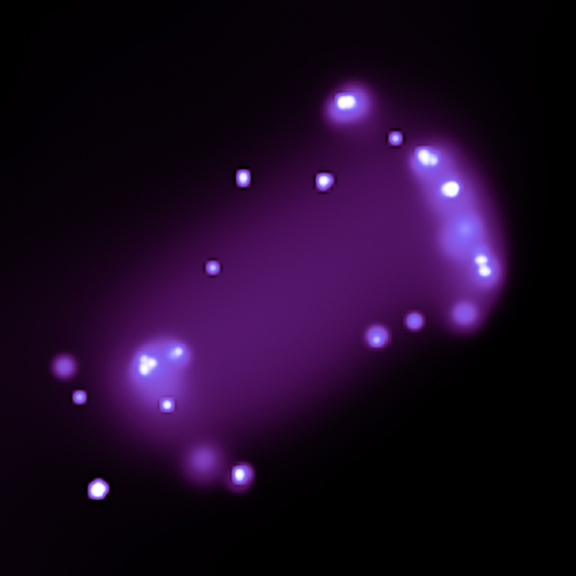
Chandra X-ray Image of the Cartwheel Galaxy
When the most massive of these stars explode as supernovas, they leave behind neutron stars and black holes. Some of these neutron stars and black holes have nearby companion stars, and have become powerful sources of X-rays as they pull matter off their companions.

The brightest X-ray sources are likely black holes with companion stars, and appear as the white dots that lie along the rim of the X-ray image. The Cartwheel contains an exceptionally large number of these black hole binary X-ray sources, because many massive stars formed in the rim.

Fast Facts for Cartwheel Galaxy:
Credit  Composite: NASA/JPL/Caltech/P.Appleton et al. X-ray: NASA/CXC/A.Wolter & G.Trinchieri et al.
Scale  Image is 160 arcsec across
Category  Normal Galaxies & Starburst Galaxies
Coordinates (J2000)  RA 0h 37m 41.10s | Dec -33º 42' 58.80"
Constellation  Sculptor
Observation Date  26 May 2001
Observation Time  21 hours
Obs. ID  2019
Orientation  North to the right, East is up.
Color Code  Ultraviolet (blue), Optical (green), X-ray (purple), Infrared (red)
Instrument  ACIS
References X-ray: A. Wolter and G. Trinchieri, Astronomy and Astrophysics, v.426, p.787-796 (2004)
Distance Estimate  About 400 million light years
Release Date  January 11, 2006

More Information on Cartwheel Galaxy:
More Images of Cartwheel Galaxy
Cartwheel Galaxy Handout: html | pdf
Zoom in on Cartwheel Galaxy (flash)
Powerpoint and PDF
Download image for your desktop
Print Gallery image of Cartwheel Galaxy
View Cartwheel Galaxy in Context (Google Sky)
Related Chandra Images:
Photo Album: M101 - Quasisoft Sources (01 Mar 04)
Photo Album: The Antennae (07 Jan 04)
Photo Album: NGC 4261 (08 Dec 03)
More Information on Normal Galaxies & Starburst Galaxies :
X-ray Astronomy Field Guide: Normal Galaxies & Starburst Galaxies
Questions and Answers: Normal Galaxies & Starburst Galaxies
Chandra Images: Normal Galaxies & Starburst Galaxies
Related Links:
Infrared Images: Spitzer Space Telescope
Optical Images: Hubble Space Telescope
Ultraviolet Images: GALEX


Chandra Images: '08 | ' 07 | ' 06 | ' 05 | ' 04 | ' 03 | ' 02 | ' 01 | ' 00 | ' 99 | Images by Category


separator line
CXC Home | Search | Help | Site Map | Image Use Policy | Privacy & Accessibility | Downloads & Plugins
Latest Images | New & Noteworthy | Multimedia | Flash Ecards | Glossary | Q&A | Guestbook


RSS Feed RSS Feed | Podcast Podcast | Blog Blog

[News by email: Chandra Digest]
[Contact us: cxcpub@cfa.harvard.edu]
NASA's Home Page Smithsonian's Home Page CXC Home Page Image Map for NASA's, Smithsonian and Chandra's Home Pages
Harvard-Smithsonian Center for Astrophysics
60 Garden Street, Cambridge, MA 02138 USA
Phone: 617.496.7941 Fax: 617.495.7356


Text Size:
normal font large font larger font
Chandra X-ray Center, Operated for NASA by the Smithsonian Astrophysical Observatory
This site was developed with funding from NASA under Contract NAS8-03060.
Revised: April 25, 2008