

Download Image


More Information


More Images

Animation & Video

Related Images


3C438:
Galaxy Cluster Takes It to the Extreme
Credit: X-ray: NASA/CXC/CfA/R.P.Kraft; Optical: Pal.Obs. DSS


Galaxy Cluster Takes It to the Extreme
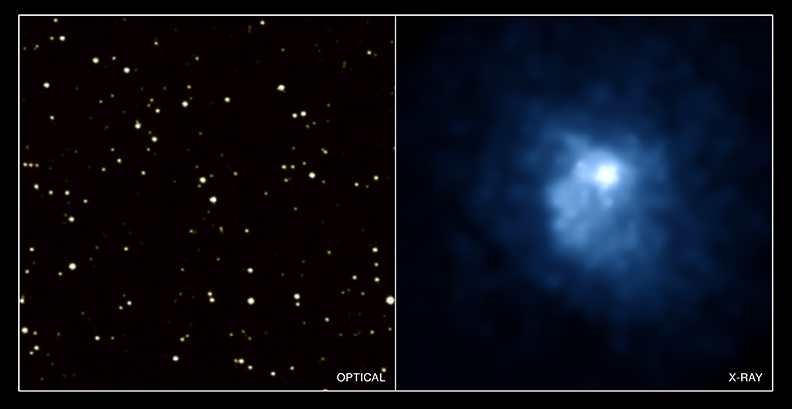
Credit: X-ray: NASA/CXC/CfA/R.P.Kraft; Optical: Pal.Obs. DSS
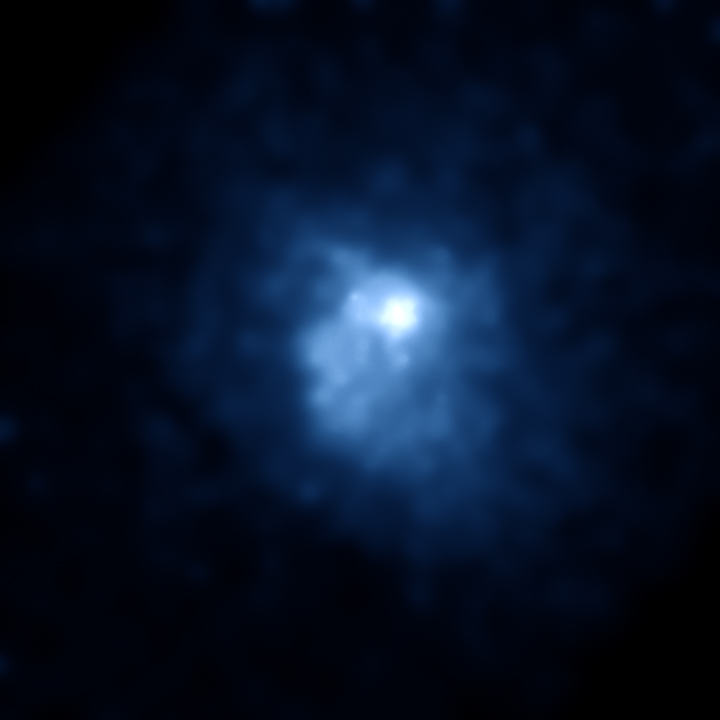
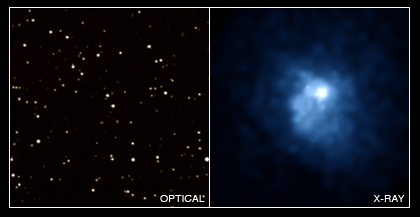
In this side-by-side comparison, an apparently ordinary star field in optical light (left) is shown to be dramatically different when observed in X-rays (right). Chandra's image of 3C438, the central galaxy within a massive cluster, reveals evidence for one of the most energetic events in the local Universe. An arc-like feature to the lower left in the cluster's hot gas is about 2 million light years long.
Astronomers have determined that an enormous amount of energy would be required to produce such a large structure. One plausible scenario is that two massive clusters collided at high velocity and later merged. This would have created a shock front in the hot gas that could account for the ridge seen in the Chandra data.
Another intriguing feature in the Chandra data is the possible detection of a cavity in the hot gas. This structure, seen in the upper left of the image, would require a tremendous amount of energy to produce. There are also hints of a similar structure on the other side of the central galaxy.
Astronomers think such X-ray cavities are usually generated when large amounts of matter funnel into a supermassive black hole. The black hole inhales much of the matter but expels some of it outward in a high-speed jet, carving space into the hot gas. If the cavity was generated by a supermassive black hole, then it would be the most powerful event of its kind ever seen.
A further interesting aspect of the Chandra data is that the temperature of the gas was measured to be about 170 million degrees Celsius. This cluster is therefore one of the hottest ever seen, another sign of colossal upheaval.
|
||||||||||||||||||||||||||||


Revised: June 07, 2022