

Tour of M101
Quicktime MPEG
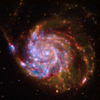
This image of the spiral galaxy Messier 101 is a composite of observations from NASA's three Great Observatories: the Chandra X-ray Observatory, the Hubble Space Telescope, and the Spitzer Space Telescope. Chandra's view in X-ray light is seen as blue and reveals multi-million-degree gas, exploded stars, and material colliding around black holes. In red, Spitzer's view in infrared light highlights the heat emitted by dust lanes in the galaxy where stars can form. The yellow shows Hubble's data in visible light. Most of this light also comes from stars, and they trace the same spiral structure as the dust lanes. Such multi-wavelength images allow astronomers to see how features in one wavelength match up with those in another, and give everyone a more complete picture of this beautiful galaxy.
[Runtime: 00:48]
Quicktime MPEG
This image of the spiral galaxy Messier 101 is a composite of observations from NASA's three Great Observatories: the Chandra X-ray Observatory, the Hubble Space Telescope, and the Spitzer Space Telescope. Chandra's view in X-ray light is seen as blue and reveals multi-million-degree gas, exploded stars, and material colliding around black holes. In red, Spitzer's view in infrared light highlights the heat emitted by dust lanes in the galaxy where stars can form. The yellow shows Hubble's data in visible light. Most of this light also comes from stars, and they trace the same spiral structure as the dust lanes. Such multi-wavelength images allow astronomers to see how features in one wavelength match up with those in another, and give everyone a more complete picture of this beautiful galaxy.
[Runtime: 00:48]
(Credit: X-ray: NASA/CXC/JHU/K.Kuntz et al.; Optical: NASA/ESA/STScI/JHU/K. Kuntz et al; IR: NASA/JPL-Caltech/STScI/K. Gordon)
Return to M101 (February 10, 2009)




Revised: April 23, 2020