

March 01, 2004
NASA RELEASE: 04-076
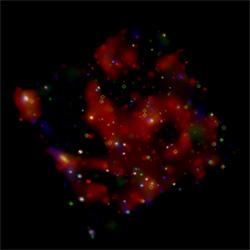
Mysterious, powerful X-ray sources found in nearby galaxies may represent a new class of objects, according to data from NASA's Chandra X-ray Observatory. These sources, which are not as hot as typical neutron-star or black-hole X- ray sources, could be a large new population of black holes with masses several hundred times that of the sun.
"The challenge raised by the discovery of these sources is to understand how they produce so much X-ray power at temperatures of a few million degrees," said Rosanne Di Stefano from the Harvard-Smithsonian Center for Astrophysics in Cambridge, Mass., and Tufts University in Medford, Mass. Di Stefano is lead author of a series of papers published in or submitted to The Astrophysical Journal and The Astrophysical Journal Letters.
Until a few years ago, astronomers only knew of two sizes of black holes: stellar black holes, with masses about 10 times the sun, and supermassive black holes located at the centers of galaxies, with masses ranging from millions to billions times the sun. Recent evidence suggests a class of "intermediate- mass" black holes may also exist.

Searching for quasisoft sources may be a new way to identify those X-ray sources most likely to be intermediate-mass black holes," said Albert Kong of the Center for Astrophysics (CfA) and a member of the team.
The enigmatic objects found by the Chandra team are called "quasisoft" sources, because they have a temperature in the range of 1 million to 4 million degrees Celsius. On the one hand this temperature range is below the 10 million to 100 million-degree gas associated with "hard" X-ray sources, such as neutron stars or stellar-mass black holes. On the other hand the quasisoft-source temperatures are hotter than the several hundred-thousand-degree gas associated with "supersoft" X-ray sources due to white dwarfs.

Di Stefano and her colleagues determined the temperatures of individual X-ray emitting objects in four galaxies by measuring their X-ray spectra, or distribution of X-rays with energy. They found that between 15 percent and 20 percent of all detected sources fell in the quasisoft temperature range.
The power output of quasisoft sources is comparable to or greater than that of neutron stars or stellar-mass black holes fueled by the infall of matter from companion stars. This implies the region that produces the X-rays in a quasisoft

One possibility is the quasisoft sources represent standard neutron stars or stellar black holes where the associated hot gas cloud is, for some as yet unknown reason, much larger than usual. Or the quasisoft X-rays could be coming from the vicinity of intermediate-mass black holes having masses a hundred or more times greater than the mass of the sun. This would increase the diameter of the event horizon and could explain the larger sizes and lower temperatures associated with quasisoft sources.
As more quasisoft sources are discovered, the types of galaxies in which they reside and where they are located in a galaxy should give astronomers additional clues as to their nature. The present study indicates that they occur in various locations in elliptical as well as spiral galaxies.
Di Stefano and her CfA team observed quasisoft sources in several galaxies with Chandra including M101, M83, M51 and NGC 4697. NASA's Marshall Space Flight Center, Huntsville, Ala., manages the Chandra program for NASA's Office of Space Science, Washington. Northrop Grumman of Redondo Beach, Calif., formerly TRW, Inc., was the prime development contractor for the observatory. The Smithsonian Astrophysical Observatory controls science and flight operations from the Chandra X-ray Center in Cambridge, Mass.
Additional information and images are available at:
MEDIA CONTACTS
Donald Savage
NASA Headquarters, Washington, DC
Phone: 202-358-1727
Steve Roy
Marshall Space Flight Center, Huntsville, AL
Phone: 256-544-6535
Megan Watzke
Chandra X-ray Observatory Center, CFA, Cambridge, MA
Phone: 617-496-7998
cxcpress@cfa.harvard.edu




Revised: March 31, 2008