

May 10, 2005
NASA RELEASE 05-120
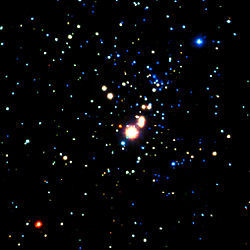
New results from NASA's Chandra X-ray Observatory imply that X-ray super-flares torched the young Solar System. Such flares likely affected the planet-forming disk around the early Sun, and may have enhanced the survival chances of Earth.
By focusing on the Orion Nebula almost continuously for 13 days, a team of scientists used Chandra to obtain the deepest X-ray observation ever taken of this or any star cluster. The Orion Nebula is the nearest rich stellar nursery, located just 1,500 light years away.
These data provide an unparalleled view of 1400 young stars, 30 of which are prototypes of the early Sun. The scientists discovered that these young suns erupt in enormous flares that dwarf - in energy, size, and frequency -- anything seen from the Sun today.

"We don't have a time machine to see how the young Sun behaved, but the next best thing is to observe Sun-like stars in Orion," said Scott Wolk of Harvard-Smithsonian Center for Astrophysics in Cambridge, Mass. "We are getting a unique look at stars between one and 10 million years old - a time when planets form."
A key result is that the more violent stars produce flares that are a hundred times as energetic as the more docile ones. This difference may specifically affect the fate of planets that are relatively small and rocky, like the Earth.
"Big X-ray flares could lead to planetary systems like ours where Earth is a safe distance from the Sun," said Eric Feigelson of Penn State University in University Park, and principal investigator for the international Chandra Orion Ultradeep Project. "Stars with smaller flares, on the other hand, might end up with Earth-like planets plummeting into the star."

According to recent theoretical work, X-ray flares can create turbulence when they strike planet-forming disks, and this affects the position of rocky planets as they form. Specifically, this turbulence can help prevent planets from rapidly migrating towards the young star.
"Although these flares may be creating havoc in the disks, they ultimately could do more good than harm," said Feigelson. "These flares may be acting like a planetary protection program."
About half of the young suns in Orion show evidence for disks, likely sites for current planet formation, including four lying at the center of proplyds (proto-planetary disks) imaged by Hubble Space Telescope. X-ray flares bombard these planet-forming disks, likely giving them an electric charge. This charge, combined with motion of the disk and the effects of magnetic fields should create turbulence in the disk.

The numerous results from the Chandra Orion Ultradeep Project will appear in a dedicated issue of The Astrophysical Journal Supplement in October, 2005. The team contains 37 scientists from institutions across the world including the US, Italy, France, Germany, Taiwan, Japan and the Netherlands.
NASA's Marshall Space Flight Center, Huntsville, Ala., manages the Chandra program for NASA's Science Mission Directorate, Washington. Northrop Grumman of Redondo Beach, Calif., was the prime development contractor for the observatory. The Smithsonian Astrophysical Observatory controls science and flight operations from the Chandra X-ray Center in Cambridge, Mass.
Additional information and images are available at:
MEDIA CONTACTS
Erica Hupp
Headquarters, Washington, DC
(Phone: 202/358-1237)
Steve Roy
Marshall Space Flight Center, Huntsville, AL
Phone: 256-544-6535
Megan Watzke
Chandra X-ray Center, CfA, Cambridge, MA
Phone: 617-496-7998




Revised: March 25, 2008