

CXC Home | Search | Help | Image Use Policy | Latest Images | Privacy | Accessibility | Glossary | Q&A
1. Chandra's Archives Come to Life
QuicktimeMPEG Audio Only
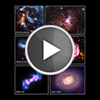
Every year, NASA's Chandra X-ray Observatory looks at hundreds of objects throughout space to help expand our understanding of the Universe. Ultimately, these data are stored in the Chandra Data Archive, an electronic repository that provides access to these unique X-ray findings for anyone who would like to explore them. With the passing of Chandra's 15th anniversary, in operation since August 26, 1999, the archive continues to grow as each successive year adds to the enormous and invaluable dataset.
To celebrate Chandra's decade and a half in space, and to honor October as American Archive Month, a variety of objects have been selected from Chandra's archive. Each of the new images we have produced combines Chandra data with those from other telescopes. This technique of creating "multiwavelength" images allows scientists and the public to see how X-rays fit with data of other types of light, such as optical, radio, and infrared. As scientists continue to make new discoveries with the telescope, the burgeoning archive will allow us to see the high-energy Universe as only Chandra can.
[Runtime: 01:27]
(NASA/CXC/A. Hobart)
Related Chandra Images:
QuicktimeMPEG Audio Only
- Audio (1.2 MB)
Every year, NASA's Chandra X-ray Observatory looks at hundreds of objects throughout space to help expand our understanding of the Universe. Ultimately, these data are stored in the Chandra Data Archive, an electronic repository that provides access to these unique X-ray findings for anyone who would like to explore them. With the passing of Chandra's 15th anniversary, in operation since August 26, 1999, the archive continues to grow as each successive year adds to the enormous and invaluable dataset.
To celebrate Chandra's decade and a half in space, and to honor October as American Archive Month, a variety of objects have been selected from Chandra's archive. Each of the new images we have produced combines Chandra data with those from other telescopes. This technique of creating "multiwavelength" images allows scientists and the public to see how X-rays fit with data of other types of light, such as optical, radio, and infrared. As scientists continue to make new discoveries with the telescope, the burgeoning archive will allow us to see the high-energy Universe as only Chandra can.
[Runtime: 01:27]
(NASA/CXC/A. Hobart)
Related Chandra Images:
- Photo Album: Chandra Archive Collection

2. Deeper Look at M51
QuicktimeMPEG Like the Milky Way, the Whirlpool is a spiral galaxy with spectacular arms of stars and dust. M51 is located about 25 million light years from Earth, and its face-on orientation to Earth gives us a perspective that we can never get of our own spiral galactic home. By studying the Whirlpool in X-ray light, astronomers can reveal things that would otherwise be invisible in other wavelengths. For example, nearly a million seconds of observing time from NASA's Chandra X-ray Observatory were used to create this new image. These data reveal over 400 X-ray sources within the galaxy. Most of these are so-called X-ray binary systems, in which a neutron star or black hole is in orbit with a star like our Sun. Understanding where these systems are, how they behave over time, and their role in the evolution of the galaxy in important is helping learn us more about other galaxies including our own.
[Runtime: 00:50]
(NASA/CXC)
Related Chandra Images:
QuicktimeMPEG Like the Milky Way, the Whirlpool is a spiral galaxy with spectacular arms of stars and dust. M51 is located about 25 million light years from Earth, and its face-on orientation to Earth gives us a perspective that we can never get of our own spiral galactic home. By studying the Whirlpool in X-ray light, astronomers can reveal things that would otherwise be invisible in other wavelengths. For example, nearly a million seconds of observing time from NASA's Chandra X-ray Observatory were used to create this new image. These data reveal over 400 X-ray sources within the galaxy. Most of these are so-called X-ray binary systems, in which a neutron star or black hole is in orbit with a star like our Sun. Understanding where these systems are, how they behave over time, and their role in the evolution of the galaxy in important is helping learn us more about other galaxies including our own.
[Runtime: 00:50]
(NASA/CXC)
Related Chandra Images:
- Photo Album: Whirlpool Galaxy

3. Pro-Am Tour
QuicktimeMPEG Audio Only
Long before the term "citizen science" was coined, the field of astronomy has benefited from countless men and women who study the sky in their spare time. These amateur astronomers devote hours exploring the cosmos through a variety of telescopes that they acquire, maintain, and improve on their own. Some of these amateur astronomers specialize in capturing what is seen through their telescopes in images and are astrophotographers.
What happens when the work of amateur astronomers and astrophotographers is combined with the data from some of the world's most sophisticated space telescopes? These four composite images of galaxies reveal the possibilities. These galaxies are M101, also known as the "Pinwheel Galaxy", M81, Centaurus A, and M51, or, the "Whirlpool Galaxy". This Astro Pro-Am collaboration intends to raise interest and awareness among the amateur astronomer/astrophotographer community of the wealth of data publicly available, such as in NASA's various mission archives. This effort is particularly appropriate for this month because April marks Global Astronomy Month, the world's largest global celebration of astronomy.
For many amateur astronomers and astrophotographers, a main goal of their efforts is to observe and share the wonders of the Universe. However, the long exposures of these objects may also help to reveal phenomena that may otherwise be missed in the relatively short snapshots taken by major telescopes, which are tightly scheduled and often oversubscribed by professional astronomers. Therefore, projects like Astro Pro-Am might one day prove useful not only for producing spectacular images, but also contributing to the knowledge of what is happening in each of these cosmic vistas.
[Runtime: 02:11]
(NASA/CXC/A. Hobart)
Related Chandra Images:
QuicktimeMPEG Audio Only
- Audio (1.9 MB)
Long before the term "citizen science" was coined, the field of astronomy has benefited from countless men and women who study the sky in their spare time. These amateur astronomers devote hours exploring the cosmos through a variety of telescopes that they acquire, maintain, and improve on their own. Some of these amateur astronomers specialize in capturing what is seen through their telescopes in images and are astrophotographers.
What happens when the work of amateur astronomers and astrophotographers is combined with the data from some of the world's most sophisticated space telescopes? These four composite images of galaxies reveal the possibilities. These galaxies are M101, also known as the "Pinwheel Galaxy", M81, Centaurus A, and M51, or, the "Whirlpool Galaxy". This Astro Pro-Am collaboration intends to raise interest and awareness among the amateur astronomer/astrophotographer community of the wealth of data publicly available, such as in NASA's various mission archives. This effort is particularly appropriate for this month because April marks Global Astronomy Month, the world's largest global celebration of astronomy.
For many amateur astronomers and astrophotographers, a main goal of their efforts is to observe and share the wonders of the Universe. However, the long exposures of these objects may also help to reveal phenomena that may otherwise be missed in the relatively short snapshots taken by major telescopes, which are tightly scheduled and often oversubscribed by professional astronomers. Therefore, projects like Astro Pro-Am might one day prove useful not only for producing spectacular images, but also contributing to the knowledge of what is happening in each of these cosmic vistas.
[Runtime: 02:11]
(NASA/CXC/A. Hobart)
Related Chandra Images:
- Photo Album: M101

4. I Can See Your Halo
QuicktimeMPEG Audio Only
The Universe is enormous and full of empty space. Light from the nearest star outside our solar system has to travel through empty black space for 4.2 years before it reaches our eyes, even though light moves faster than anything else in the Universe and we live in a very densely populated region of space! Yet somehow, despite all this empty space, galaxies crashing into each other is a fairly common sight. One such collision has been caught in this cosmic picture; which shows the enormous cloud of hot gas surrounding two large colliding galaxies called NGC 6240.
The two large spiral galaxies seen in this picture are similar in size and shape to our home galaxy, the Milky Way. Both galaxies are believed to be harbouring supermassive black holes at their centres, which are spiralling towards each other as we speak. It's likely that they will eventually merge together to form an even bigger black hole!
Another consequence of this pile up is the birth of millions of new stars in a 'stellarbaby boom' that has lasted over 200 million years! This was caused by the violent collision, which stirred up the gases in each galaxy. The baby boom resulted in the birth of many stars much more massive than the Sun. These then ended their lives in powerful supernova explosions, pumping material into the enormous gas cloud: a 'halo' of hot gas, which can be seen in this picture. And it contains enough material to make 10 billion Suns!
[Runtime: 02:01]
(NASA/CXC/April Jubett)
Related Chandra Images:
QuicktimeMPEG Audio Only
- Audio (1.4 MB)
The Universe is enormous and full of empty space. Light from the nearest star outside our solar system has to travel through empty black space for 4.2 years before it reaches our eyes, even though light moves faster than anything else in the Universe and we live in a very densely populated region of space! Yet somehow, despite all this empty space, galaxies crashing into each other is a fairly common sight. One such collision has been caught in this cosmic picture; which shows the enormous cloud of hot gas surrounding two large colliding galaxies called NGC 6240.
The two large spiral galaxies seen in this picture are similar in size and shape to our home galaxy, the Milky Way. Both galaxies are believed to be harbouring supermassive black holes at their centres, which are spiralling towards each other as we speak. It's likely that they will eventually merge together to form an even bigger black hole!
Another consequence of this pile up is the birth of millions of new stars in a 'stellarbaby boom' that has lasted over 200 million years! This was caused by the violent collision, which stirred up the gases in each galaxy. The baby boom resulted in the birth of many stars much more massive than the Sun. These then ended their lives in powerful supernova explosions, pumping material into the enormous gas cloud: a 'halo' of hot gas, which can be seen in this picture. And it contains enough material to make 10 billion Suns!
[Runtime: 02:01]
(NASA/CXC/April Jubett)
Related Chandra Images:
- Photo Album: NGC 6240
5. Giant Ring of Black Holes
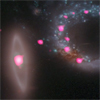
QuicktimeMPEG This image shows Arp 147, a pair of interacting galaxies some 430 million light years from Earth, as seen by the Chandra X-ray Observatory and the Hubble Space Telescope. The ring-shaped object on the right is a remnant of a spiral galaxy that collided with the elliptical galaxy to the left millions of years ago. The collision triggered a wave of star formation. Many of these new young stars raced through their evolution - in a few million years or less - and ended up as supernova explosions or black holes. X-rays from Chandra now reveal a ring of these black holes in the outer arms of the spiral structure. Researchers estimate that the nine sources around the ring are likely 10 to 20 times more massive than the Sun - a rather impressive weight for any Valentine's gift.
[Runtime: 0.20]
(X-ray: NASA/CXC/MIT/S.Rappaport et al, Optical: NASA/STScI)
Related Chandra Images:
QuicktimeMPEG This image shows Arp 147, a pair of interacting galaxies some 430 million light years from Earth, as seen by the Chandra X-ray Observatory and the Hubble Space Telescope. The ring-shaped object on the right is a remnant of a spiral galaxy that collided with the elliptical galaxy to the left millions of years ago. The collision triggered a wave of star formation. Many of these new young stars raced through their evolution - in a few million years or less - and ended up as supernova explosions or black holes. X-rays from Chandra now reveal a ring of these black holes in the outer arms of the spiral structure. Researchers estimate that the nine sources around the ring are likely 10 to 20 times more massive than the Sun - a rather impressive weight for any Valentine's gift.
[Runtime: 0.20]
(X-ray: NASA/CXC/MIT/S.Rappaport et al, Optical: NASA/STScI)
Related Chandra Images:
- Photo Album: Arp 147
6. Animation of Merger Trigger for Supernova
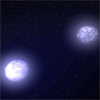
QuicktimeMPEG This animation shows the main way that new Chandra results indicate Type Ia supernova are triggered in elliptical galaxies. Two white dwarf stars orbit each other and lose energy via gravitational radiation, eventually resulting in a merger between the two stars. Because the total mass of this merger exceeds the weight limit for a white dwarf, the merged star is unstable and explodes as a Type Ia supernova.
[Runtime: 0.20]
View Stills
(NASA/CXC/A.Hobart)
Related Chandra Images:
QuicktimeMPEG This animation shows the main way that new Chandra results indicate Type Ia supernova are triggered in elliptical galaxies. Two white dwarf stars orbit each other and lose energy via gravitational radiation, eventually resulting in a merger between the two stars. Because the total mass of this merger exceeds the weight limit for a white dwarf, the merged star is unstable and explodes as a Type Ia supernova.
[Runtime: 0.20]
View Stills
(NASA/CXC/A.Hobart)
Related Chandra Images:
- Photo Album: M31
7. Great Observatory Views of Sombrero Galaxy
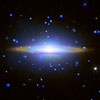
QuicktimeMPEG This is a Great Observatory view of the famous Sombrero galaxy using the Chandra, Hubble and Spitzer telescopes. The first image shows the composite version, followed by the three separate observatory views. The Chandra X-ray image (blue) shows hot gas in the galaxy and point sources that are a mixture of galaxy members and background objects. The Hubble optical image (green) shows a bulge of starlight partially blocked by a rim of dust. The Spitzer image (red) shows the rim of dust glowing in the infrared and a central bulge of stars.
[Runtime: 0.20]
(X-ray: NASA/UMass/Q.D.Wang et al.; Optical: NASA/STScI/AURA/Hubble Heritage; Infrared: NASA/JPL-Caltech/Univ. AZ/R.Kennicutt/SINGS Team)
Related Chandra Images:
QuicktimeMPEG This is a Great Observatory view of the famous Sombrero galaxy using the Chandra, Hubble and Spitzer telescopes. The first image shows the composite version, followed by the three separate observatory views. The Chandra X-ray image (blue) shows hot gas in the galaxy and point sources that are a mixture of galaxy members and background objects. The Hubble optical image (green) shows a bulge of starlight partially blocked by a rim of dust. The Spitzer image (red) shows the rim of dust glowing in the infrared and a central bulge of stars.
[Runtime: 0.20]
(X-ray: NASA/UMass/Q.D.Wang et al.; Optical: NASA/STScI/AURA/Hubble Heritage; Infrared: NASA/JPL-Caltech/Univ. AZ/R.Kennicutt/SINGS Team)
Related Chandra Images:
- Photo Album: M104
8. Images of M33 X-7
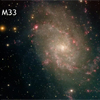
QuicktimeMPEG This sequence begins with a wide-field optical image from Kitt Peak of M33, a spiral galaxy about 3 million light years from Earth, and then zooms into a view from the Gemini telescope on Mauna Kea, Hawaii. Next, the view zooms into an even smaller field, from the Hubble Space Telescope, that includes M33 X-7, the most massive known black hole to be formed from the collapse of a star. The final image is a composite of the region around M33 X-7 that contains both the Chandra and Hubble data.
[Runtime: 0:35]
(Kitt Peak: NOAO/AURA/NSF/T.A.Rector; Gemini: AURA/Gemini Obs./SDSU/J.Orosz et al.; HST: NASA/STScI/SDSU/J.Orosz et al.; Chandra: NASA/CXC/CfA/P.Plucinsky et al.)
QuicktimeMPEG This sequence begins with a wide-field optical image from Kitt Peak of M33, a spiral galaxy about 3 million light years from Earth, and then zooms into a view from the Gemini telescope on Mauna Kea, Hawaii. Next, the view zooms into an even smaller field, from the Hubble Space Telescope, that includes M33 X-7, the most massive known black hole to be formed from the collapse of a star. The final image is a composite of the region around M33 X-7 that contains both the Chandra and Hubble data.
[Runtime: 0:35]
(Kitt Peak: NOAO/AURA/NSF/T.A.Rector; Gemini: AURA/Gemini Obs./SDSU/J.Orosz et al.; HST: NASA/STScI/SDSU/J.Orosz et al.; Chandra: NASA/CXC/CfA/P.Plucinsky et al.)
9. Zoom into Spiral Galaxy C153
QuicktimeMPEG This video zooms into the C153 spiral galaxy found in the galaxy cluster Abell 2125. The initial view moves from the NOAO telescope wide-field mosaic into the Hubble Wide Field Planetary Camera 2 image of C153. The Hubble image then dissolves into the composite detail of X-ray, radio and optical images.
[Runtime: ]
(NASA/STScI)
QuicktimeMPEG This video zooms into the C153 spiral galaxy found in the galaxy cluster Abell 2125. The initial view moves from the NOAO telescope wide-field mosaic into the Hubble Wide Field Planetary Camera 2 image of C153. The Hubble image then dissolves into the composite detail of X-ray, radio and optical images.
[Runtime: ]
(NASA/STScI)



Revised: March 24, 2023