Q&A: General Astronomy and Space Science
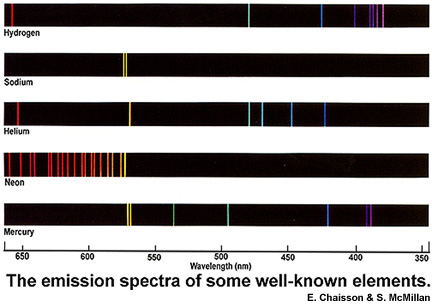
I would like to know what the order of the spectrum would look
like if we looked at a light made of neon by using a telescope
or some other instruments.
All elements exhibit
characteristic spectral emission lines. The predominant emission
lines of a gas, like Neon, are also very sensitive to and
dependent on the temperature of the gas. For gas with
temperatures of a few thousand Kelvins, most of the lines are
emitted in the visible portion of the spectrum, so only an
optical telescope would be able to see such gas. The emission
lines from gas with temperatures of approximately 100,000
Kelvins fall in the UV portion of the spectrum, and the emission
lines from even hotter gas fall in the X-ray portion of the
spectrum. In general, telescopes sensitive to higher energy
photons see hotter gas.