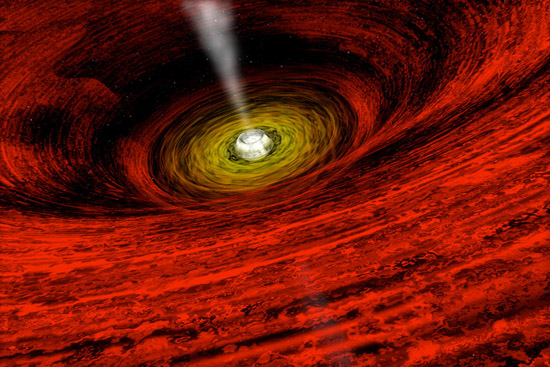
Q&A: Black Holes
How can an X-ray telescope observe X-rays from a black hole? I
thought nothing could escape from a black hole.
You are correct in saying that nothing can escape a black hole (if
you ignore the evaporation of black holes, an effect studied by
Stephen Hawking and others which takes many times the age of the
universe to be effective for black holes with stellar masses, so
it can safely be ignored!). As matter is drawn closer and closer
toward a black hole the particles are heated to extreme
temperatures and produce X-rays. Depending on how fast the black
hole is rotating, X-rays can escape from a distance ranging from
90 (non-rotating) down to 15 (maximum rotation) kilometers from
the event horizon (point of no return) of a black hole.
Astrophysicists hope to use the increased sensitivity of Chandra
to prove just how close the matter they observe is to the event
horizon.