Doing More with More
Back in 2002, we released a colorful image of the star-forming region known as 30 Doradus (also called the Tarantula Nebula.) At the time, we thought it was a beautiful image – and it was – of this pocket of intense stellar birth and death in the neighboring Large Magellanic Cloud.
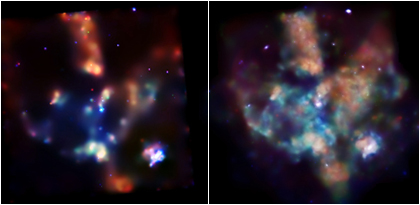
Chandra's 30 Doradus from 2002 (left) and 2008 (right)
As much as we liked the old one, we think the new one (released December 11, 2008) is even better. What makes this latest one different? The answer is simple: observing time. The “exposure time†of this new image was roughly equivalent to 30 hours – that’s over three times as long as the image from 2002. More time means more photons collected, which, in turn, means more data to go into the image. While we still hold a place in our hearts for the images from Chandra’s younger days, we always look forward to what it will see next.
-Megan Watzke, CXC
Please note this is a moderated blog. No pornography, spam, profanity or discriminatory remarks are allowed. No personal attacks are allowed. Users should stay on topic to keep it relevant for the readers.
Read the privacy statement