New Version of Chandra Source Catalog Released
Submitted by chandra on Mon, 2024-04-22 15:21
The Chandra Source Catalog (CSC) is the definitive catalog of X-ray sources detected by the observatory. The latest version, known as CSC 2.1, was released in early April 2024.
Since the Uhuru satellite in the 1970s, X-ray astrophysics missions have a tradition of publishing detailed catalogs of the X-ray sources detected along with a list of key physical properties.
CSC 2.1. carries this tradition forward. Below is an adapted announcement from members of the team who worked on this important resource for the scientific community:
The Chandra X-ray Center (CXC) is pleased to announce the availability of Release 2.1 of the Chandra Source Catalog (CSC 2.1). This catalog covers roughly 730 square degrees of sky and contains 407,806 unique X-ray sources and over 1.3 million individual source detections identified in more than 15,000 Chandra imaging observations released publicly prior to the end of 2021.
Chandra and Voyager: A Robust 3D Experience
Submitted by chandra on Wed, 2024-04-17 17:18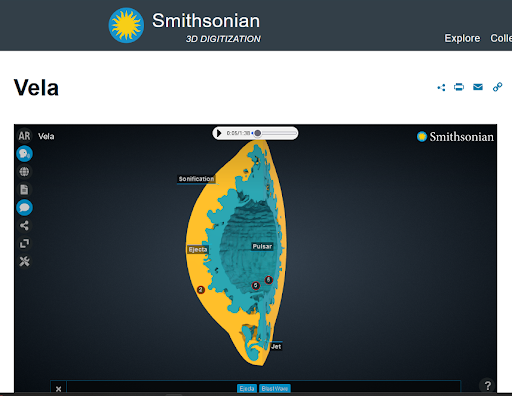
A screenshot from the Smithsonian Voyager 3D platform: Vela Pulsar is shown here with its ejecta and blast wave turned on. Explore the Vela sonification and visual description tour while tumbling around the 3D model and turning the ejecta and blast wave on and off. Download an stl model for 3D printing to hold the Vela Pulsar in your hand.
Credit: INAF-Observatorio Astronomico di Palermo/S.Orlando & NASA/CXC/SAO/A. Jubett et al; Smithsonian Institution/J. Cope, M. Dattoria et al;
The creative team at Chandra X-ray Center has been hard at work on a collaboration with the Smithsonian Institution’s Digitization Program Office (3D SI). Together, our teams have been bringing three-dimensional X-ray datasets to the Voyager platform to offer inclusive, multi-sensory learning experiences.
The Chandra X-ray Observatory is one of NASA's “Great Observatories” (along with the Hubble Space Telescope and the James Webb Telescope). Chandra, the world's most powerful X-ray telescope, is still going strong after 25 years in orbit. The Smithsonian Astrophysical Observatory (SAO) in Massachusetts operates the telescope and runs the science center on behalf of NASA.
In 2021, Chandra and 3D SI released a collection of cosmic models showing various high-energy phenomena in three dimensions including novas, supernovas, pulsars, and the Chandra telescope itself. These 3D representations provided the opportunity for users to tumble around each object and learn about its features and the science behind the model. This has been a huge step in granting greater access to these incredible 3D models and prints for institutions like libraries and museums, as well as the scientific community and individuals in the greater public.
Scientists from Brown, NASA and the Smithsonian Bring Cosmic Explorations to Smartphones
Submitted by chandra on Wed, 2024-04-17 15:21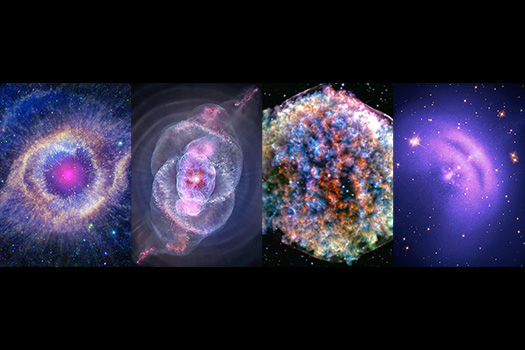
The following press release from Brown University, being released in conjunction with another from the Smithsonian Institution, highlights an exciting new project that brings cosmic objects in 3D to Instagram “experiences.” This project was led by Dr. Kimberly Arcand of the Smithsonian Astrophysical Observatory that runs the Chandra X-ray Center on behalf of NASA. These new Chandra Instagram experiences are the first ever to include sonifications (translations of data into sound) and represent a new way of making astronomical data more accessible.
By using a phone camera and a new set of Instagram augmented reality filters, anyone can dive into the depths of space, encountering nebulae, pulsars and even remnants of exploded stars.
Gaze at the ethereal colors of distant nebulae. Zoom in to the heart of an exploded star. Listen to chimes, bells and electric rhythms representing a celestial object far off in space. Through new Instagram filters, users of the app can now embark on cosmic journeys through their smartphones with space-themed augmented reality experiences.
The filters are fun, for sure — but they’re also grounded in some serious science. The experiences were created by researchers from Brown University, Smithsonian Astrophysical Observatory and NASA to celebrate the 25th anniversary the Chandra spacecraft, NASA’s flagship X-ray telescope. The goals are to engage the public, make images of space more accessible and add new layers of understanding to some of the most well-known and widely studied objects in the sky.
Celebrate the 25th anniversary of NASA’s Chandra X-ray Observatory with us
Submitted by chandra on Mon, 2024-03-18 14:36
Celebrate the
25th anniversary of
NASA’s Chandra
X-ray Observatory with us
The Chandra X-ray Observatory is unlike any other telescope. Since its launch into space on July 23, 1999, Chandra has been NASA’s flagship mission for X-ray astronomy in the fleet of “Great Observatories.”
Chandra discovers exotic new phenomena and examines old mysteries, looking at objects within our own Solar System out to nearly the edge of the observable Universe.
Chandra makes significant discoveries on its own, but also in concert with other telescopes and instruments in the quest to understand the Universe.
Chandra’s imaging capabilities and observing efficiency still exceed pre-launch requirements after 25 years of operations. The observatory is capable of many more years of operation and scientific discovery. Many current themes in astrophysics, along with new NASA facilities to address these, rely on unique information from Chandra.
Chandra is capable of discoveries that no other telescopes can make.

Chandra sees X-rays, a critical and unique window into the hottest and most energetic places in the Universe.
Chandra has sharper X-ray vision than any other X-ray telescope — current or planned for
decades to come.
We are on the precipice of so many discoveries. What wonders will come next?
Listen to the Universe: New NASA Sonifications and Documentary
Submitted by chandra on Mon, 2024-02-26 15:16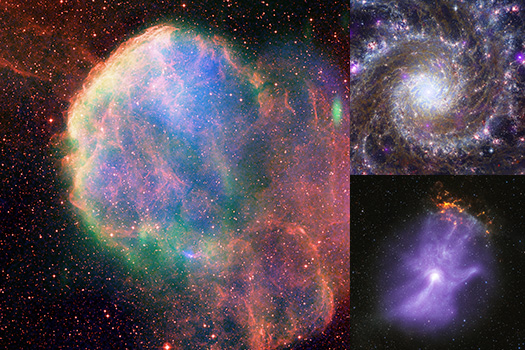
IC 443, M74, and MSH 15-52
Sonification Credit: NASA/CXC/SAO/K.Arcand, SYSTEM Sounds (M. Russo, A. Santaguida)
Three new sonifications of images from NASA’s Chandra X-ray Observatory and other telescopes have been released. This work is also being featured in a new NASA+ documentary, "Listen to the Universe."
Sonification is the process of translating data into sounds. In the case of Chandra and other telescopes, scientific data are collected from space as digital signals that are commonly turned into visual imagery. The sonification project takes these data through another step of mapping the information into sound.
Sensational New "Pro-Am" View of Cas A
Submitted by chandra on Mon, 2023-11-27 13:24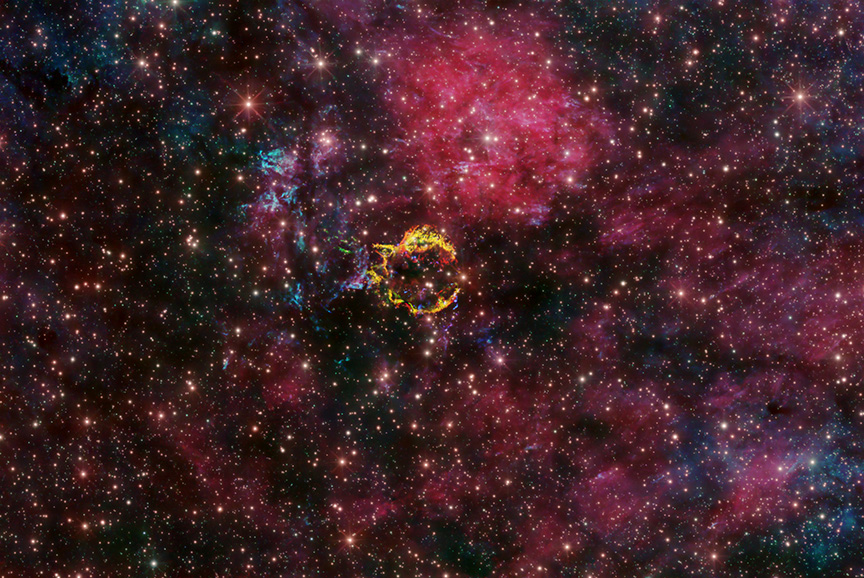
Cassiopeia A
Contributors: Tim Schaeffer, William Ostling, Justin, Adrien Keijzer, Paul Kent, BTB Astroteam Brentenriegel, Steve Gill, Tino Heuberger, Nicolas Puig, Julian Shapiro, Felix Schöfbänker, Mikhail Vasilev, David Wood
In sports, the term “pro-am” refers to a competition between professional and non-professional athletes. In astronomy, there are also “pro-am” events, but these are highly collaborative and never cutthroat.
AstroBin is an image hosting platform and social network for astrophotographers (also often known as “amateur astronomers”, though their skill and expertise should never be questioned!)
NASA Telescope Data Becomes Music You Can Play
Submitted by chandra on Wed, 2023-11-15 10:39Credit: Composition: NASA/CXC/SAO/Sophie Kastner: Data: X-ray: NASA/CXC/SAO; Optical: NASA/STScI; IR: Spitzer NASA/JPL-Caltech; Sonification: NASA/CXC/SAO/K.Arcand, SYSTEM Sounds (M. Russo, A. Santaguida); Video Credit: NASA/CXC/A. Jubett & P. David
For millennia, musicians have looked to the heavens for inspiration. Now a new collaboration is enabling actual data from NASA telescopes to be used as the basis for original music that can be played by humans.
Since 2020, the “sonification” project at NASA’s Chandra X-ray Center has translated the digital data taken by telescopes into notes and sounds. This process allows the listener to experience the data through the sense of hearing instead of seeing it as images, a more common way to present astronomical data.
A new phase of the sonification project takes the data into different territory. Working with composer Sophie Kastner, the team has developed versions of the data that can be played by musicians.
A Fab Five: New Images With NASA's Chandra X-ray Observatory
Submitted by chandra on Tue, 2023-09-12 16:32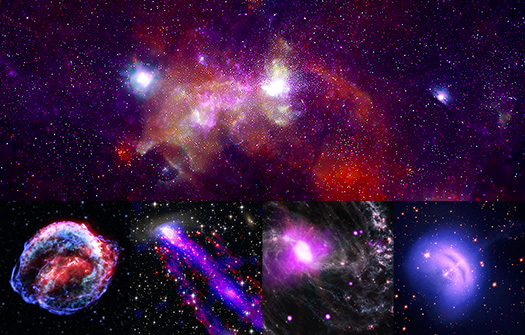
A new collection of stunning images highlights data from NASA’s Chandra X-ray Observatory and other telescopes.
Credit: NASA/CXC/SAO, JPL-Caltech, MSFC, STScI, ESA/CSA, SDSS, ESO
A new collection of stunning images highlights data from NASA’s Chandra X-ray Observatory and other telescopes. These objects have been observed in light invisible to human eyes — including X-rays, infrared, and radio — by some of the world’s most powerful telescopes. The data from different types of light has been assigned colors that the human eye can perceive, allowing us to explore these cosmic entities.
The objects in this quintet of images range both in distance and category. Vela and Kepler are the remains of exploded stars within our own Milky Way galaxy, the center of which can be seen in the top panorama. In NGC 1365, we see a double-barred spiral galaxy located about 60 million light-years from Earth. Farther away and on an even larger scale, ESO 137-001 shows what happens when a galaxy hurtles through space and leaves a wake behind it.
Welcoming a New Member of the X-ray Family
Submitted by chandra on Fri, 2023-08-25 10:27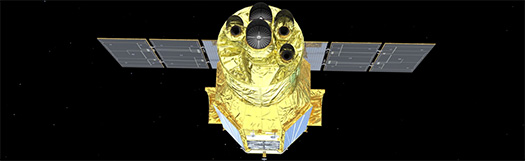
Artist's concept of the XRISM (X-ray Imaging and Spectroscopy Mission) spacecraft.
Credit: NASA's Goddard Space Flight Center Conceptual Image Lab
On September 6th, a new X-ray telescope was launched into space, joining the Chandra X-ray Observatory, XMM-Newton, and others already exploring the high-energy Universe.
The X-ray Imaging and Spectroscopy Mission (XRISM, pronounced “crism”) is led by the Japanese Aerospace Exploration Agency, or JAXA, with contributions from NASA and the European Space Agency.
What will scientists use XRISM for? This feature from NASA describes some of what is can do and the embedded video does an excellent job explaining why ‘spectroscopy’ is so important to astronomers and their study of the Universe.
https://www.nasa.gov/feature/feature/2023/xrism-spacecraft-will-open-new...
New Technique Improves Clarity of Chandra Images
Submitted by chandra on Tue, 2023-06-27 13:59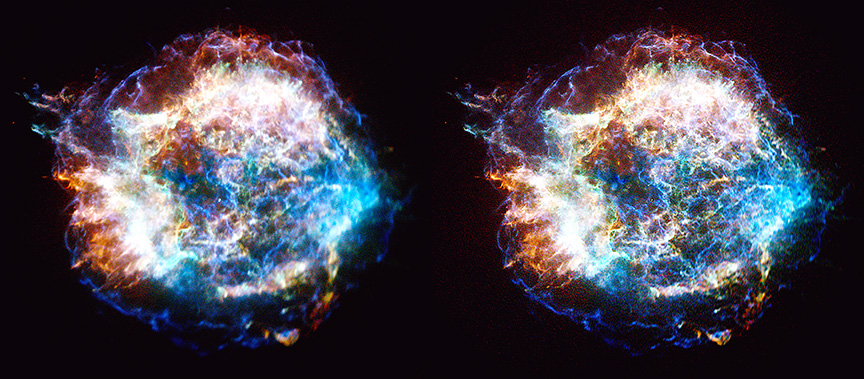
A team of researchers has announced the development of a new way to process X-ray data from NASA’s Chandra X-ray Observatory. This technique will improve the clarity, or sharpness, of some Chandra’s images, including the Cassiopeia A supernova remnant. According to a press release from Rikkyo University in Japan, this new method corrects for the differences in focusing power in different parts of Chandra's images, and could “lead to improved measurement accuracy and the discovery of unknown structures.”
Pages
Please note this is a moderated blog. No pornography, spam, profanity or discriminatory remarks are allowed. No personal attacks are allowed. Users should stay on topic to keep it relevant for the readers.
Read the privacy statement
Help | Site Map | Image Use Policy | Privacy | Accessibility | Downloads & Plugins | Glossary | Q & A | New & Noteworthy | CXC Science
the Smithsonian Astrophysical Observatory
This site was developed with funding from NASA
under contract NAS8-03060.
Harvard-Smithsonian Center for Astrophysics
60 Garden Street, Cambridge, MA 02138 USA
Phone: 617.496.7941 Fax: 617.495.7356