Chandra X-ray Observatory - HomeAbout The ChandraEducational MaterialsField GuidePhoto AlbumPress RoomResources
Chandra X-ray Observatory - HomeChandra Photo Album - You are here
ObservatoryImages by DateImages by CategorySky MapConstellationsSpecial FeaturesChandra Zoom-insImage HandoutsScale Bar ImagesTutorial Chandra Images & False Color Note on Cosmic DistanceCosmic Look Back TimeScale & DistanceScale & Angular MeasurementImage Use
Web Site ToolsVisit the Chandra ChroniclesEmail NewsletterSite MapNew & NoteworthyImage Use PolicyQuestions & AnswersGlossaryDownload Guide

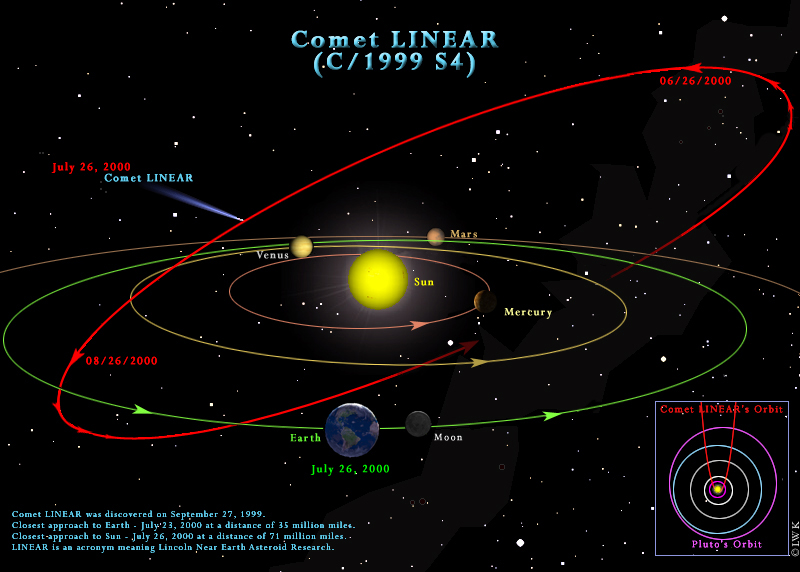
Comet C/1999 S4 (LINEAR):
Chandra Solves Mystery Of Cometary X-Rays
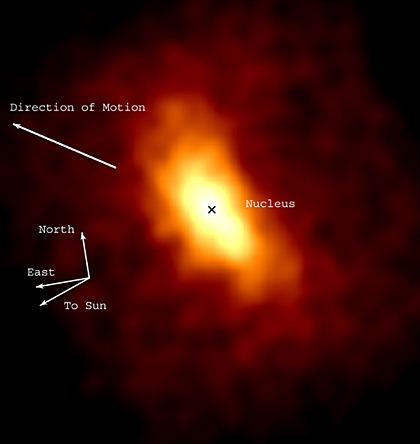
Comet C/1999 S4
Credit: NASA/CXC/C.Lisse, S.Wolk, et al.

JPEG (31.6 kb) Tiff (17.3 MB) PS (4.4 MB)
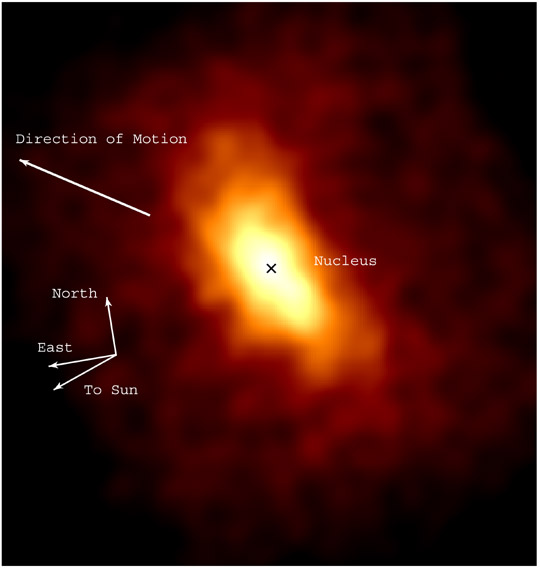
X-rays from Comet C/1999 S4 (LINEAR). On July 14, 2000 the Chandra X-ray Observatory imaged the comet repeatedly for a total of 2 ½ hours and detected X-rays from oxygen and nitrogen ions. The details of the X-ray emission, as recorded on Chandra's Advanced CCD Imaging Spectrometer, show that the X-rays are produced by collisions of ions racing away from the Sun (solar wind) with gas in the comet. In the collision the solar ion captures an electron from a cometary atom into a high energy state. The solar ion then kicks out an X-ray as the electron drops to a lower energy state.

The Chandra observations showed variations in the amount of X-rays produced by the comet. These were probably due to a solar flare that occurred on July 12 which would have increased the intensity of the solar wind.

Previously, several models had been proposed to explain how comets could produce X-rays. The Chandra observation of C/1999 S4 proves the model described above. Now it is possible to study the chemistry of the solar wind, and the structure of the comet's atmosphere.

The colors represent the intensity of the X-rays with white being the most intense, then yellow, orange, and red.

Note: Chandra's image of Comet LINEAR was updated to incorporate new data that brings out the faint extended emission around the comet, correctly label the position of the nucleus, and remove certain processing artifacts. The original image, released in July 2000, can be found in the More Images section. [24 Jan 03]

Fast Facts for Comet C/1999 S4:
Credit  NASA/CXC/C.Lisse, S.Wolk, et al.
Scale  Image is 10 x 10 arcmin
Category  Solar System
Observation Dates  July 14, 2000
Observation Time  3 hours
Obs. IDs  1748-1754, 0584
Color Code  Intensity
Instrument  ACIS
Distance Estimate  Comet C/1999 S4 (LINEAR) was approximately 120 million kilometers from Earth at the time of observation
Release Date  July 27, 2000
More Information on Comet C/1999 S4:
Press Room: Comet C/1999 S4
More Images of Comet C/1999 S4
Comet C/1999 S4 Handout: html | pdf
Powerpoint and PDF
Related Chandra Images:
Photo Album: Saturn (08 Mar 04)
More Information on Solar System:
X-ray Astronomy Field Guide: Solar System
Questions and Answers: Solar System
Chandra Images: Solar System


Chandra Images: '08 | ' 07 | ' 06 | ' 05 | ' 04 | ' 03 | ' 02 | ' 01 | ' 00 | ' 99 | Images by Category


separator line
CXC Home | Search | Help | Site Map | Image Use Policy | Privacy & Accessibility | Downloads & Plugins
Latest Images | New & Noteworthy | Multimedia | Flash Ecards | Glossary | Q&A | Guestbook


RSS Feed RSS Feed | Podcast Podcast | Blog Blog

[News by email: Chandra Digest]
[Contact us: cxcpub@cfa.harvard.edu]
NASA's Home Page Smithsonian's Home Page CXC Home Page Image Map for NASA's, Smithsonian and Chandra's Home Pages
Harvard-Smithsonian Center for Astrophysics
60 Garden Street, Cambridge, MA 02138 USA
Phone: 617.496.7941 Fax: 617.495.7356


Text Size:
normal font large font larger font
Chandra X-ray Center, Operated for NASA by the Smithsonian Astrophysical Observatory
This site was developed with funding from NASA under Contract NAS8-03060.
Revised: February 08, 2008