Chandra X-ray Observatory - HomeAbout The ChandraEducational MaterialsField GuidePhoto AlbumPress RoomResources
Chandra X-ray Observatory - HomeChandra Photo Album - You are here
ObservatoryImages by DateImages by CategorySky MapConstellationsSpecial FeaturesChandra Zoom-insImage HandoutsScale Bar ImagesTutorial Chandra Images & False Color Note on Cosmic DistanceCosmic Look Back TimeScale & DistanceScale & Angular MeasurementImage Use
Web Site ToolsVisit the Chandra ChroniclesEmail NewsletterSite MapNew & NoteworthyImage Use PolicyQuestions & AnswersGlossaryDownload Guide

The Antennae:
Chandra Finds Abundance of Ultraluminous X-ray Sources
Antennae
Credit: NASA/SAO/CXC/G.Fabbiano et al.

JPEG (38.2 kb) Tiff (669.1 kb) PS (6 MB)
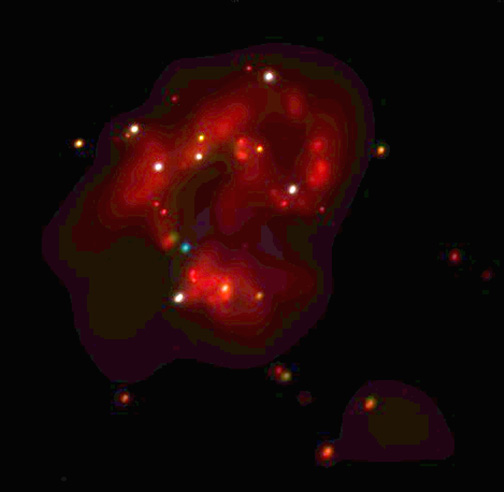
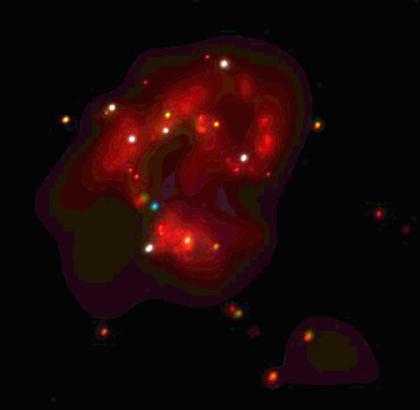
This Chandra X-ray image shows the central regions of two colliding galaxies known collectively as "The Antennae." The latest Chandra data reveal a large population of extremely bright X-ray sources in this area of intense star formation. These "ultraluminous" X-ray sources, which emit 10 to several hundred times more X-ray power than similar sources in our own Galaxy, are believed to be either massive black holes, or black holes that are beaming their energy toward Earth. In this X-ray image, red represents the low energy band, green intermediate and blue the highest observed energies. The white and yellow sources are those that emit significant amounts of both low- and high-energy X-rays.

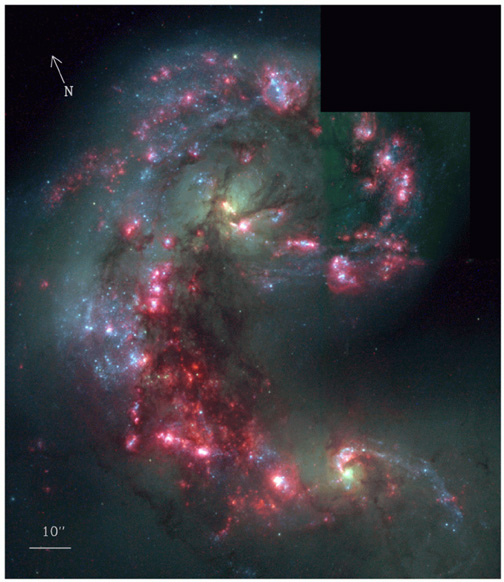
The Antennae Galaxies, about 60 million light years from Earth in the constellation Corvus, got their nickname from the wispy antennae-like streams of gas seen by optical telescopes. These wisps are believed to have been produced by the collision between the galaxies that began about 100 million years ago and is still occurring.

Fast Facts for Antennae:
Credit  NASA/SAO/CXC/G.Fabbiano et al.
Scale  Image is 4.0 arcmin on a side.
Category  Normal Galaxies & Starburst Galaxies
Coordinates (J2000)  RA 12h 01m 53.70s | Dec -18° 52' 35.5''
Constellation  Corvus
Observation Dates  December 1, 1999
Observation Time  20 hours
Color Code  Intensity
Instrument  ACIS
Also Known As NGC 4038, NGC 4039
Distance Estimate  About 60 million light years
Release Date  June 05, 2001
More Information on Antennae:
Press Room: Antennae
More Images of Antennae
Antennae Handout: html | pdf
Powerpoint and PDF
Download image for your desktop
Other Chandra Releases for Antennae:
Photo Album: Antennae (07 Jan 04)
Photo Album: Antennae (16 Aug 00)
Related Chandra Images:
Photo Album: NGC 253 (5 Jun 01)
Photo Album: M82 (True Color) (5 Jun 01)
More Information on Normal Galaxies & Starburst Galaxies :
X-ray Astronomy Field Guide: Normal Galaxies & Starburst Galaxies
Questions and Answers: Normal Galaxies & Starburst Galaxies
Chandra Images: Normal Galaxies & Starburst Galaxies


Chandra Images: '08 | ' 07 | ' 06 | ' 05 | ' 04 | ' 03 | ' 02 | ' 01 | ' 00 | ' 99 | Images by Category


separator line
CXC Home | Search | Help | Site Map | Image Use Policy | Privacy & Accessibility | Downloads & Plugins
Latest Images | New & Noteworthy | Multimedia | Flash Ecards | Glossary | Q&A | Guestbook


RSS Feed RSS Feed | Podcast Podcast | Blog Blog

[News by email: Chandra Digest]
[Contact us: cxcpub@cfa.harvard.edu]
NASA's Home Page Smithsonian's Home Page CXC Home Page Image Map for NASA's, Smithsonian and Chandra's Home Pages
Harvard-Smithsonian Center for Astrophysics
60 Garden Street, Cambridge, MA 02138 USA
Phone: 617.496.7941 Fax: 617.495.7356


Text Size:
normal font large font larger font
Chandra X-ray Center, Operated for NASA by the Smithsonian Astrophysical Observatory
This site was developed with funding from NASA under Contract NAS8-03060.
Revised: January 03, 2008