




CXC Home | Search | Help | Image Use Policy | Latest Images | Privacy | Accessibility | Glossary | Q&A
Download Image
More Information
More Images
Animation & Video
More Releases


Related Images


Sagittarius A*:
Milky Way Monster Stars in Cosmic Reality Show


Milky Way Monster Stars in Cosmic Reality Show
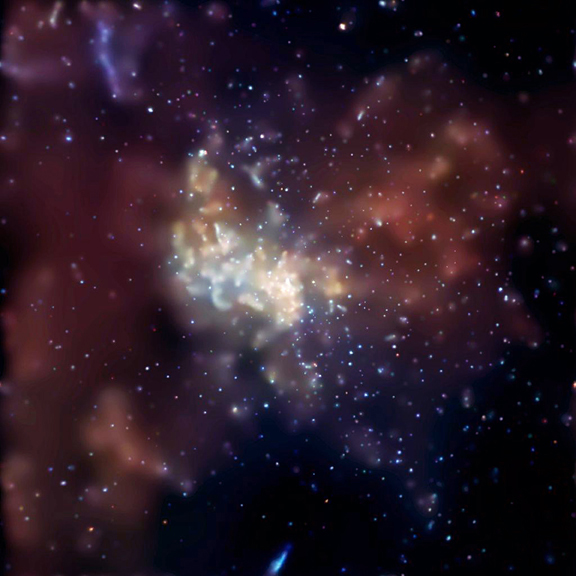
This Chandra image of the supermassive black hole at our Galaxy's center, a.k.a. Sagittarius A* or Sgr A*, was made from the longest X-ray exposure of that region to date. In addition to Sgr A* more than two thousand other X-ray sources were detected in the region, making this one of the richest fields ever observed.
During the two-week observation period, Sgr A* flared up in X-ray intensity half a dozen or more times. The cause of these outbursts is not understood, but the rapidity with which they rise and fall indicates that they are occurring near the event horizon, or point of no return, around the black hole. Even during the flares the intensity of the X-ray emission from the vicinity of the black hole is relatively weak. This suggests that Sgr A*, weighing in at 3 million times the mass of the Sun, is a starved black hole, possibly because explosive events in the past have cleared much of the gas from around it.
Evidence for such explosions was revealed in the image - huge lobes of 20 million-degree Centigrade gas (the red loops in the image at approximately the 2 o'clock and 7 o'clock positions) that extend over dozens of light years on either side of the black hole. They indicate that enormous explosions occurred several times over the last ten thousand years.
Further analysis of the Sgr A* image is expected to give astronomers a much better understanding of how the supermassive black hole in the center of our galaxy grows and how it interacts with its environment. This knowledge will also help to understand the origin and evolution of even larger supermassive black holes found in the centers of other galaxies.
|
||||||||||||||||||||||||||||
Visual Description:
This Chandra image of the supermassive black hole at our Galaxy's center, a.k.a. Sagittarius A* or Sgr A*, was made from the longest X-ray exposure of that region at the time of observation. In addition to Sgr A* more than two thousand other X-ray sources were detected in the region, making this one of the richest fields ever observed. Visually, at the center of the image, there is a bright, lumpy object showing the intense X-ray radiation emanating from the Sgr A* black hole. In the surrounding area, there are several smaller, greenish-blue lumps layered throughout the image. The image appears textured, like dozens of purple, greenish-blue and white glow worms are paused in their wriggling. Studies suggests that Sgr A*, weighing in at 3 million times the mass of the Sun, is a starved black hole, possibly because explosive events in the past have cleared much of the gas from around it. Evidence for such explosions was revealed in the image via huge lobes of 20 million-degree gas shown as large dark purple-red loops in the image at approximately the 2 o'clock and 7 o'clock positions. The ‘loops†extend over dozens of light years on either side of the black hole. They indicate that enormous explosions occurred several times over the last ten thousand years.


Revised: September 05, 2025