

Download Image


More Information


More Images
Chandra X-ray Image of GRB 031203
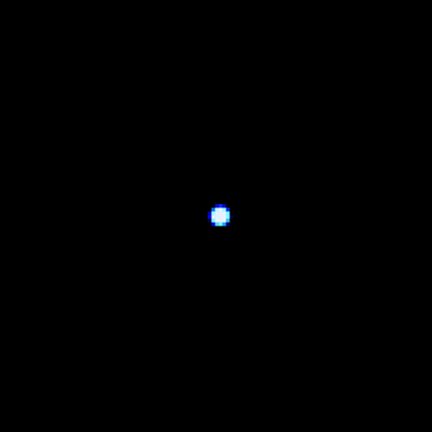
(Credit: NASA/CXC/Caltech/A.Soderberg et al.)

Related Images


GRB 031203:
Astronomers Identify a Substandard Gamma-Ray Burst
Credit: CXC/M.Weiss; Inset: NASA/CXC/Caltech/A.Soderberg et al.


Astronomers Identify a Substandard Gamma-Ray Burst
Credit: CXC/M.Weiss; Inset: NASA/CXC/Caltech/A.Soderberg et al.
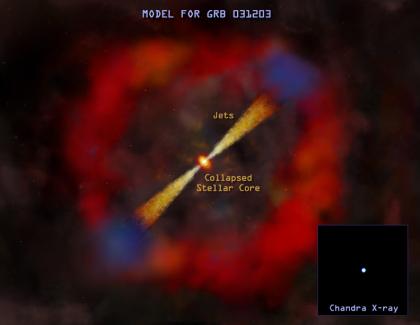
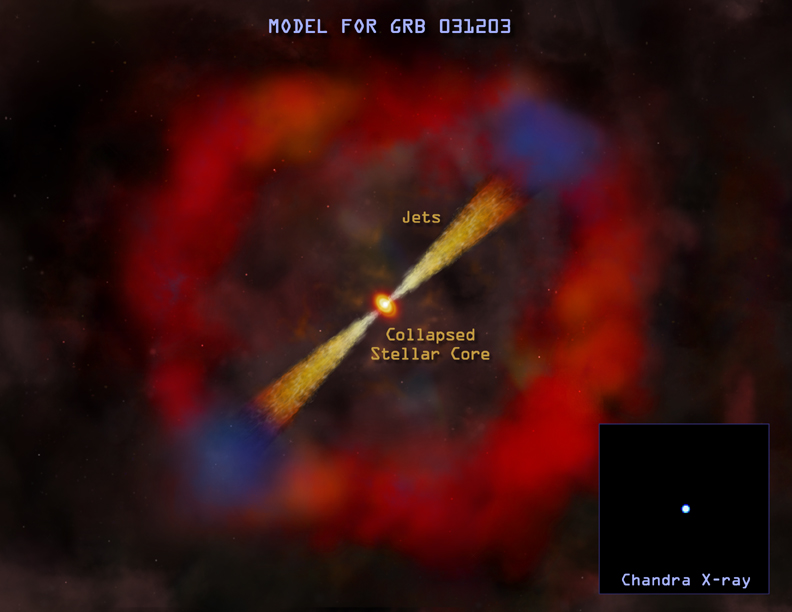
This illustration of a gamma-ray burst depicts GRB 031203, a burst that was discovered by the European Space Agency's Integral gamma-ray observatory on December 3, 2003. The afterglow of the burst was studied months later by Chandra (see inset) and other space and ground-based observatories. Based on these observations, astronomers have concluded that GRB 031203 radiated only a fraction of the energy of a normal gamma ray burst, but still produced more energy than a supernova.
This discovery suggests that an entire population of sub-energetic gamma-ray bursts, intermediate between normal gamma ray bursts and supernovas, has so far gone unnoticed. GRB 031203 is further evidence that the two types of explosions may be related. Both types of cosmic explosions are thought to result when a massive star exhausts its nuclear fuel, and its core collapses to form a neutron star or black hole.
Many examples exist where the collapse of a massive star's core to a neutron star has produced a supernova, but what occurs when a black hole forms is uncertain. Popular models postulate that gamma ray bursts are produced when the stellar core collapses to form a rapidly rotating black hole that pulls in some nearby material and flings the rest out in oppositely directed jets of gas traveling at near the speed of light. The discovery of GRB 031203, along with another intermediate energy gamma-ray burst, GRB 980425, should give astronomers valuable clues to the processes responsible for supernovas, black hole formation, and gamma ray bursts.
|
||||||||||||||||||||||||||||


Revised: June 04, 2022