Chandra X-ray Observatory - HomeAbout The ChandraEducational MaterialsField GuidePhoto AlbumPress RoomResources
Chandra X-ray Observatory - HomeChandra Photo Album - You are here
ObservatoryImages by DateImages by CategorySky MapConstellationsSpecial FeaturesChandra Zoom-insImage HandoutsScale Bar ImagesTutorial Chandra Images & False Color Note on Cosmic DistanceCosmic Look Back TimeScale & DistanceScale & Angular MeasurementImage Use
Web Site ToolsVisit the Chandra ChroniclesEmail NewsletterSite MapNew & NoteworthyImage Use PolicyQuestions & AnswersGlossaryDownload Guide

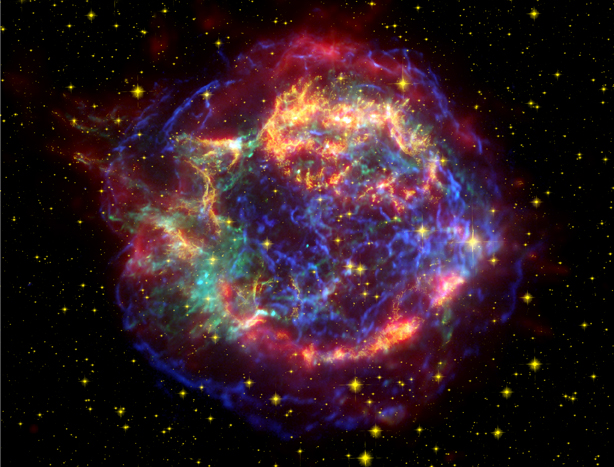
Cassiopeia A in Many Colors

Cassiopeia A
Credit: X-ray: NASA/CXC/SAO; Optical: NASA/STScI; Infrared: NASA/JPL-Caltech
JPEG (346.3 kb) Tiff (14.2 MB) PS (4.1 MB)
zoom Zoom into Cassiopeia A (flash)
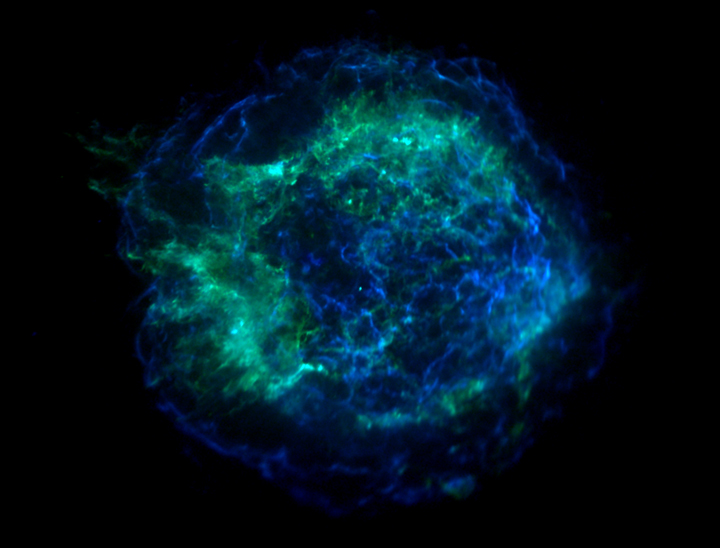
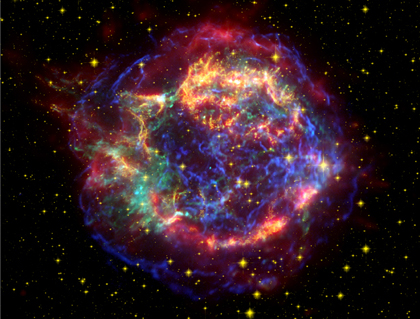
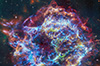
This stunning picture of the supernova remnant Cassiopeia A (Cas A) is a composite of images taken by three of NASA's Great Observatories. Infrared data from the Spitzer Space Telescope are colored red; optical data from the Hubble Space Telescope are yellow; and X-ray data from the Chandra X-ray Observatory are green and blue.

Cas A is the 300-year-old remnant created by the supernova explosion of a massive star. Each Great Observatory image highlights different characteristics of the remnant. Spitzer reveals warm dust in the outer shell with temperatures of about 10 degrees Celsius (50 degrees Fahrenheit), and Hubble sees the delicate filamentary structures of warmer gases about 10,000 degrees Celsius. Chandra shows hot gases at about 10 million degrees Celsius. This hot gas was created when ejected material from the supernova smashed into surrounding gas and dust at speeds of about ten million miles per hour.

A comparison of the infrared and X-ray images of Cas A should enable astronomers to better understand how relatively cool dust grains can coexist in the superhot gas that produces the X-rays. It should also help to determine whether most of the dust in the supernova remnant came from the massive star before it exploded, or from the rapidly expanding supernova ejecta.

The turquoise dot at the center of the shell may be a neutron star created during the supernova. Blue Chandra data were acquired using broadband X-rays (low through high energies); green Chandra data correspond only to intermediate energy X-rays; yellow Hubble data were taken using a 900 nanometer-wavelength filter, and red Spitzer data are from the telescope's 24-micron detector.

Fast Facts for Cassiopeia A:
Credit  X-ray: NASA/CXC/SAO; Optical: NASA/STScI; Infrared: NASA/JPL-Caltech
Scale  Image is 8 arcmin per side.
Category  Supernovas & Supernova Remnants
Coordinates (J2000)  RA 23h 23m 26.7s | Dec +58° 49' 03.00"
Constellation  Cassiopeia
Observation Dates  9 pointings between Feb 8 - May 5, 2004
Observation Time  11 days, 14 hours
Color Code  Energy (Infrared = red; Optical = yellow; X-ray = blue & green)
Instrument  ACIS
Also Known As Cas A
References D. Hines et al. 2004, Astrophys. Journal Supplement 154:290-295
Distance Estimate  About 10,000 light years
Release Date  June 13, 2005

More Information on Cassiopeia A:
More Images of Cassiopeia A
Cassiopeia A Handout: html | pdf
Zoom in on Cassiopeia A (flash)
Cassiopeia A Animations
Powerpoint and PDF
Download image for your desktop
View Cassiopeia A in Context (Google Sky)
Related Chandra Images:
Photo Album: Cassiopeia A (23 Aug 04)
Photo Album: Cassiopeia A (19 Aug 02)
Photo Album: Cassiopeia A (27 Jun 00)
Photo Album: Cassiopeia A (21 Dec 99)
Photo Album: Cassiopeia A (26 Aug 99)
Related Sites:
Spitzer Space Telescope: spitzer.caltech.edu
Hubble Space Telescope: hubblesite.org
More Information on Supernovas & Supernova Remnants :
X-ray Astronomy Field Guide: Supernovas & Supernova Remnants
Questions and Answers: Supernovas & Supernova Remnants
Chandra Images: Supernovas & Supernova Remnants


Chandra Images: '08 | ' 07 | ' 06 | ' 05 | ' 04 | ' 03 | ' 02 | ' 01 | ' 00 | ' 99 | Images by Category


separator line
CXC Home | Search | Help | Site Map | Image Use Policy | Privacy & Accessibility | Downloads & Plugins
Latest Images | New & Noteworthy | Multimedia | Flash Ecards | Glossary | Q&A | Guestbook


RSS Feed RSS Feed | Podcast Podcast | Blog Blog

[News by email: Chandra Digest]
[Contact us: cxcpub@cfa.harvard.edu]
NASA's Home Page Smithsonian's Home Page CXC Home Page Image Map for NASA's, Smithsonian and Chandra's Home Pages
Harvard-Smithsonian Center for Astrophysics
60 Garden Street, Cambridge, MA 02138 USA
Phone: 617.496.7941 Fax: 617.495.7356


Text Size:
normal font large font larger font
Chandra X-ray Center, Operated for NASA by the Smithsonian Astrophysical Observatory
This site was developed with funding from NASA under Contract NAS8-03060.
Revised: July 25, 2008