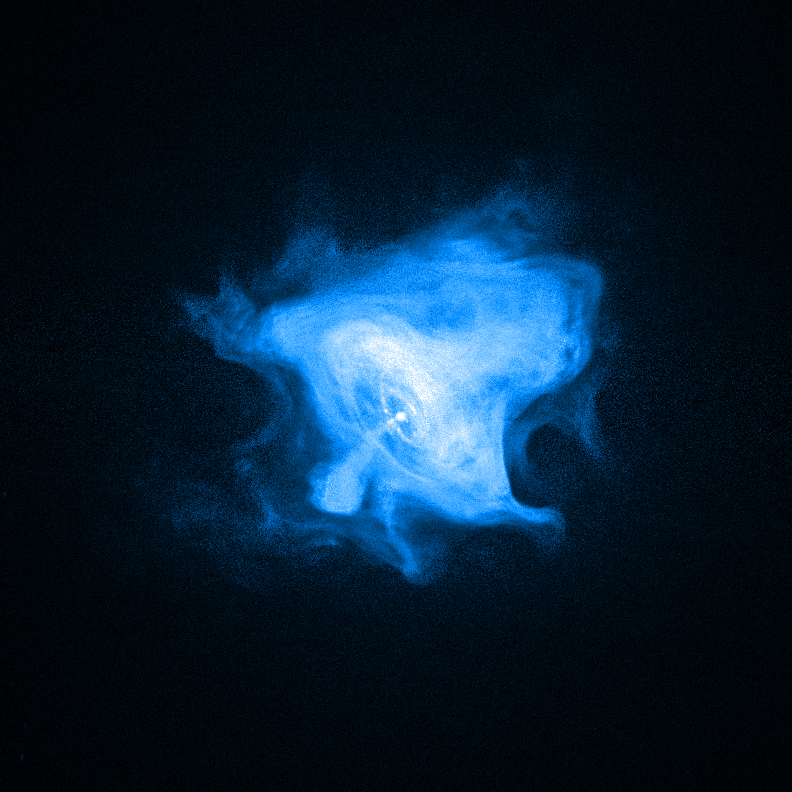
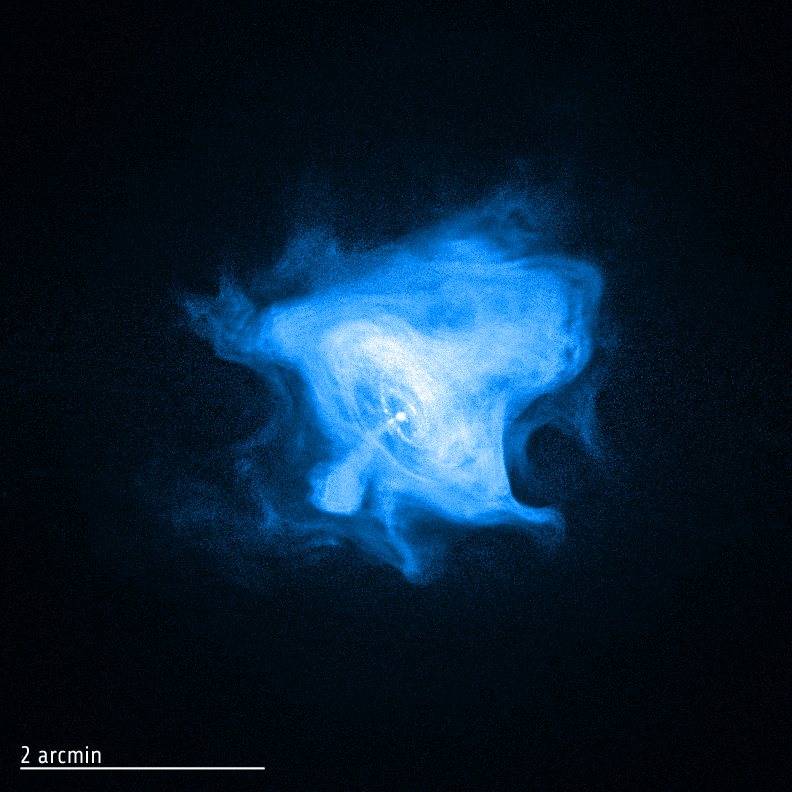
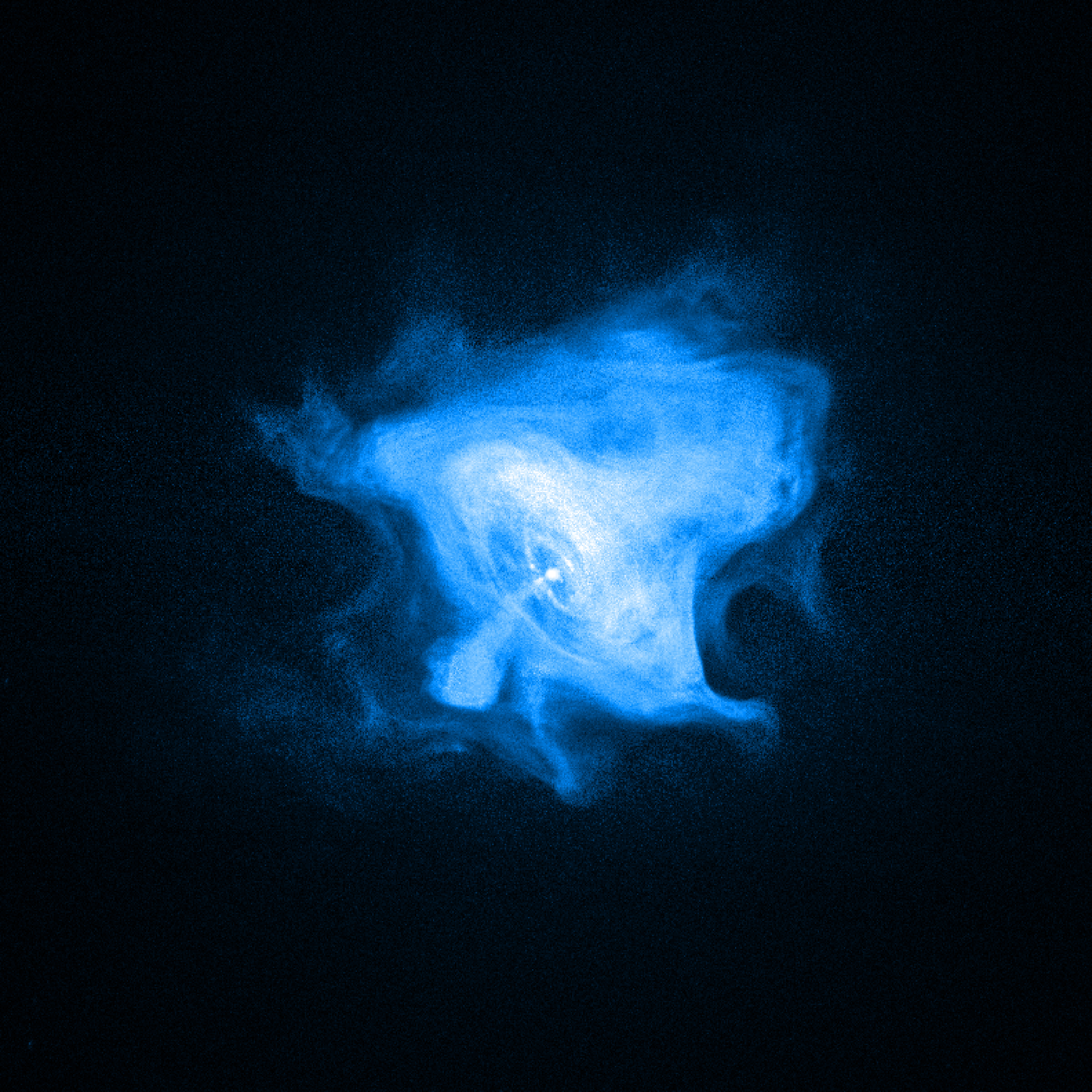
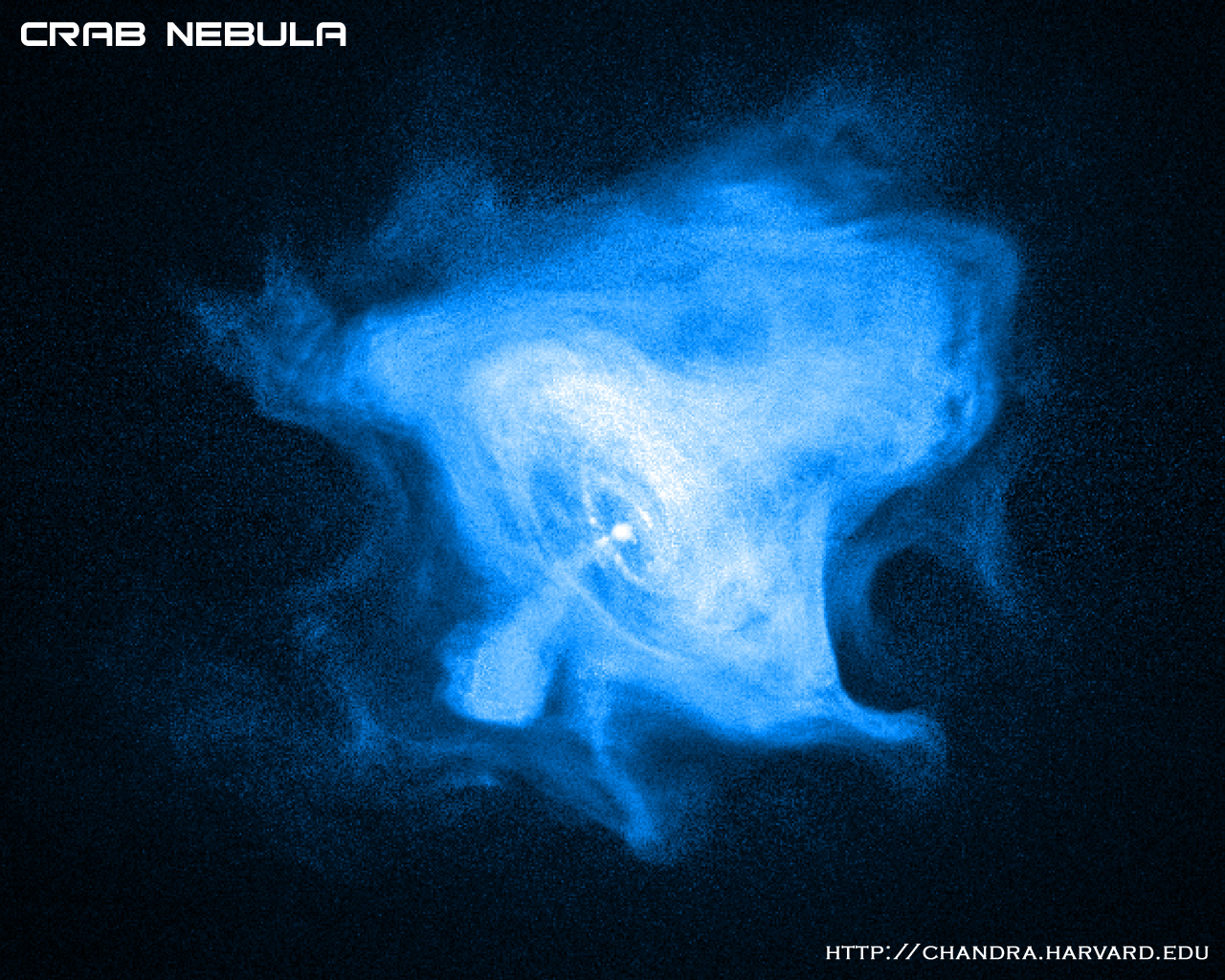
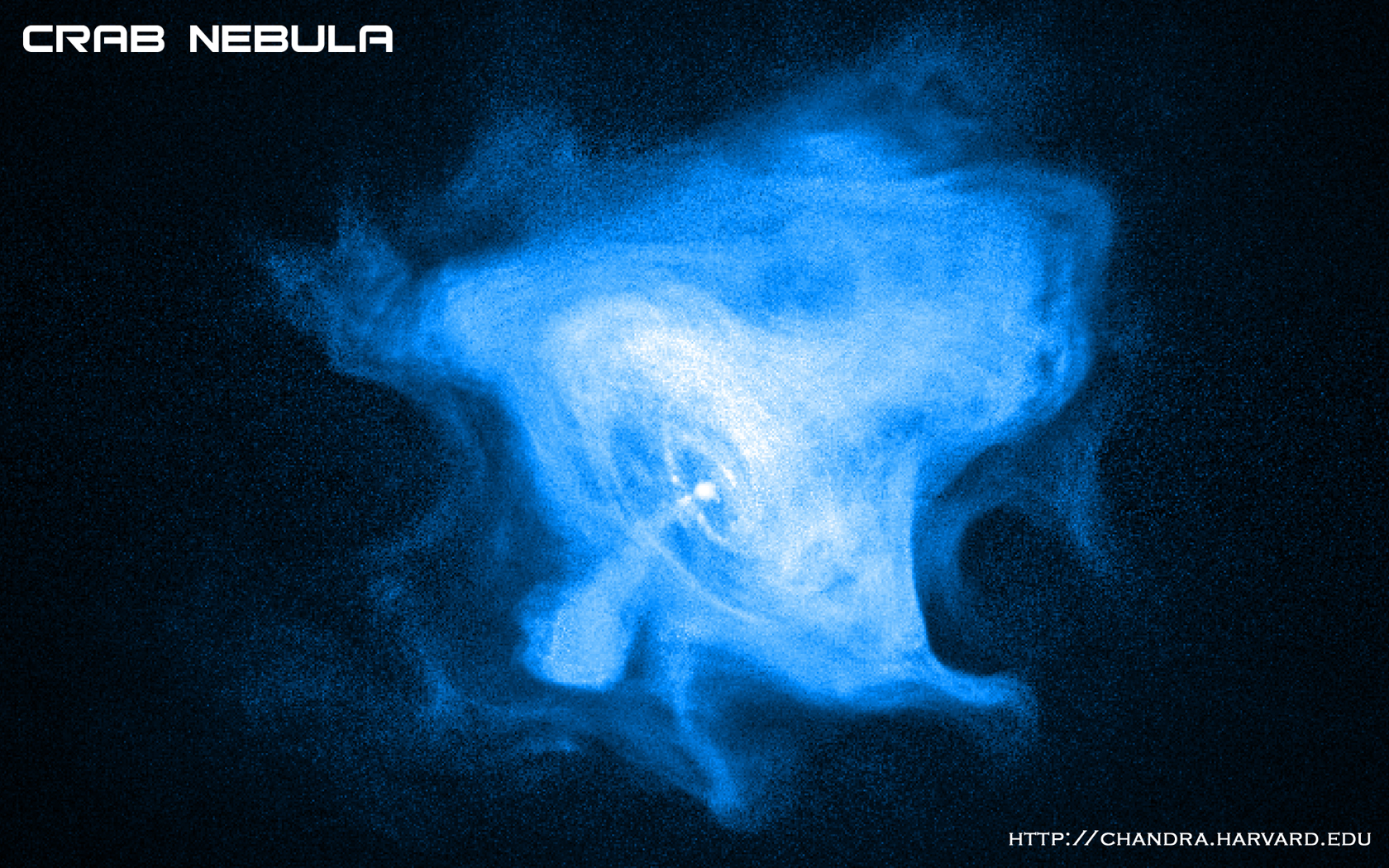
This image gives the first clear view of the faint boundary of the Crab Nebula's X-ray-emitting pulsar wind nebula. The nebula is powered by a rapidly rotating, highly magnetized neutron star, or pulsar (white dot near the center). The combination of rapid rotating and strong magnetic field generates an intense electromagnetic field that creates jets of matter and anti-matter moving away from the north and south poles of the pulsar, and an intense wind flowing out in the equatorial direction.
The inner X-ray ring is thought to be a shock wave that marks the boundary between the surrounding nebula and the flow of matter and antimatter particles from the pulsar. Energetic electrons and positrons (antielectrons) move outward from this ring to brighten the outer ring and produce an extended X-ray glow.
The fingers, loops, and bays in the image all indicate that the magnetic field of the nebula and filaments of cooler matter are controlling the motion of the electrons and positrons. The particles can move rapidly along the magnetic field and travel several light years before radiating away their energy. In contrast, they move much more slowly perpendicular to the magnetic field, and travel only a short distance before losing their energy.
This effect can explain the long, thin, fingers and loops, as well as the sharp boundaries of the bays. The conspicuous dark bays on the lower right and left are likely due to the effects of a toroidal magnetic field that is a relic of the progenitor star.
| Fast Facts for Crab Nebula: |
| Credit |
NASA/CXC/SAO/F.Seward et al |
| Release Date |
November 5, 2008 |
| Scale |
Image is 5 arcmin across. |
| Category |
Supernovas & Supernova Remnants, Neutron Stars/X-ray Binaries |
| Coordinates (J2000) |
RA 05h 34m 32s | Dec +22° 0.0' 52.00" |
| Constellation |
Taurus |
| Observation Date |
03/14/2001 and 01/27/2004
|
| Observation Time |
12 hours |
| Obs. ID |
1997, 4607
|
| Instrument |
ACIS
|
| Also Known As | NGC 1952 | | References | F.Seward et al 2006, ApJ, 652, 1277 |
| Color Code |
Intensity |
| Distance Estimate |
About 6,500 light years
|
|