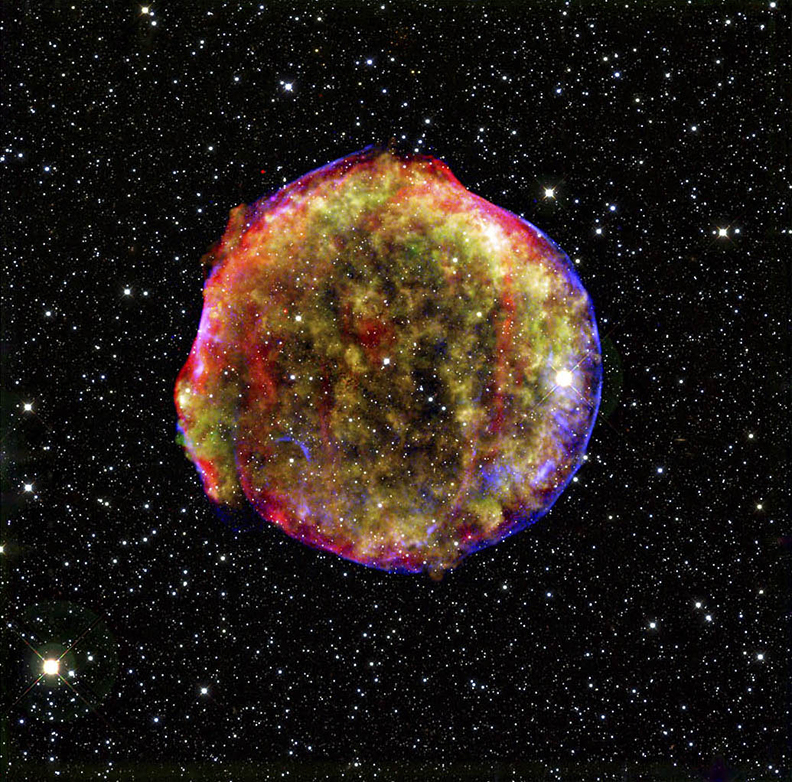
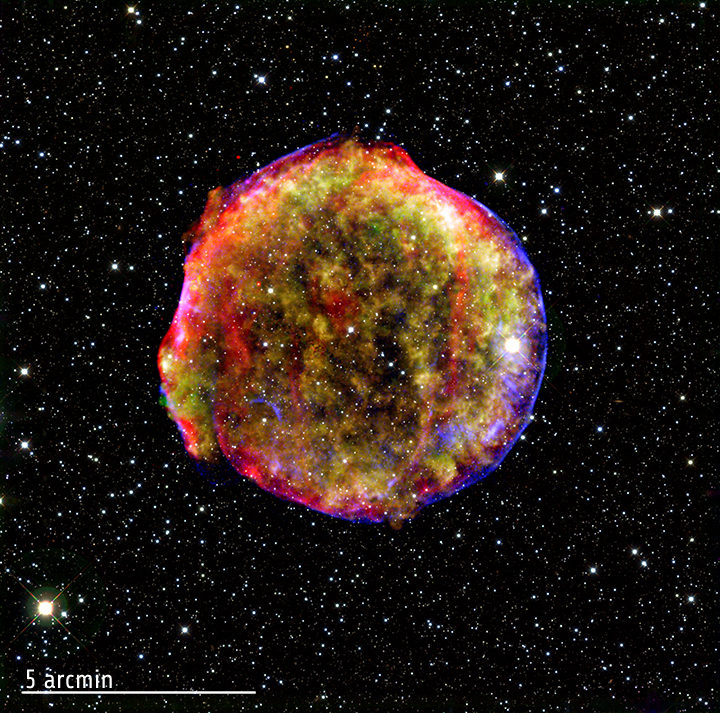
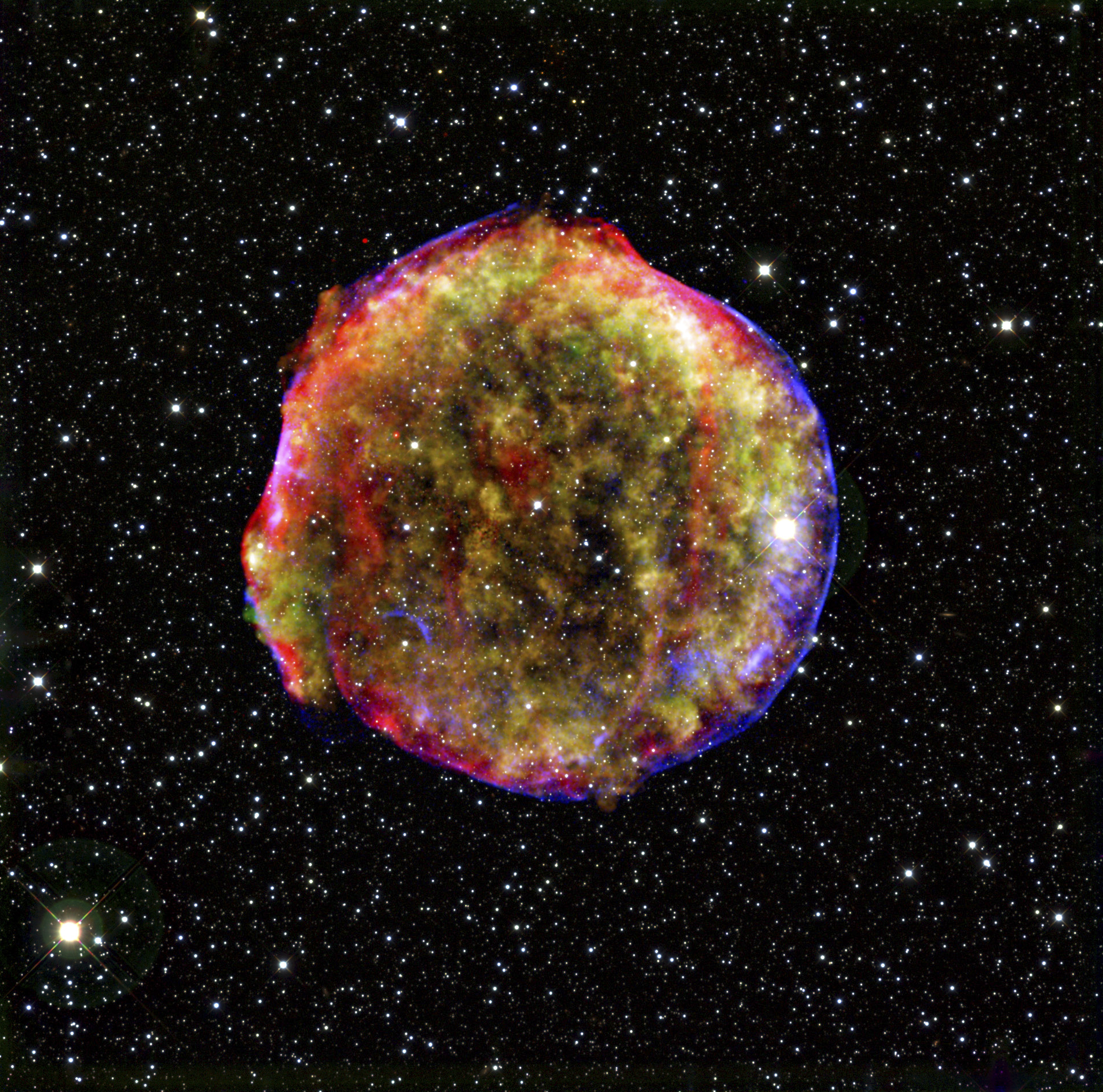
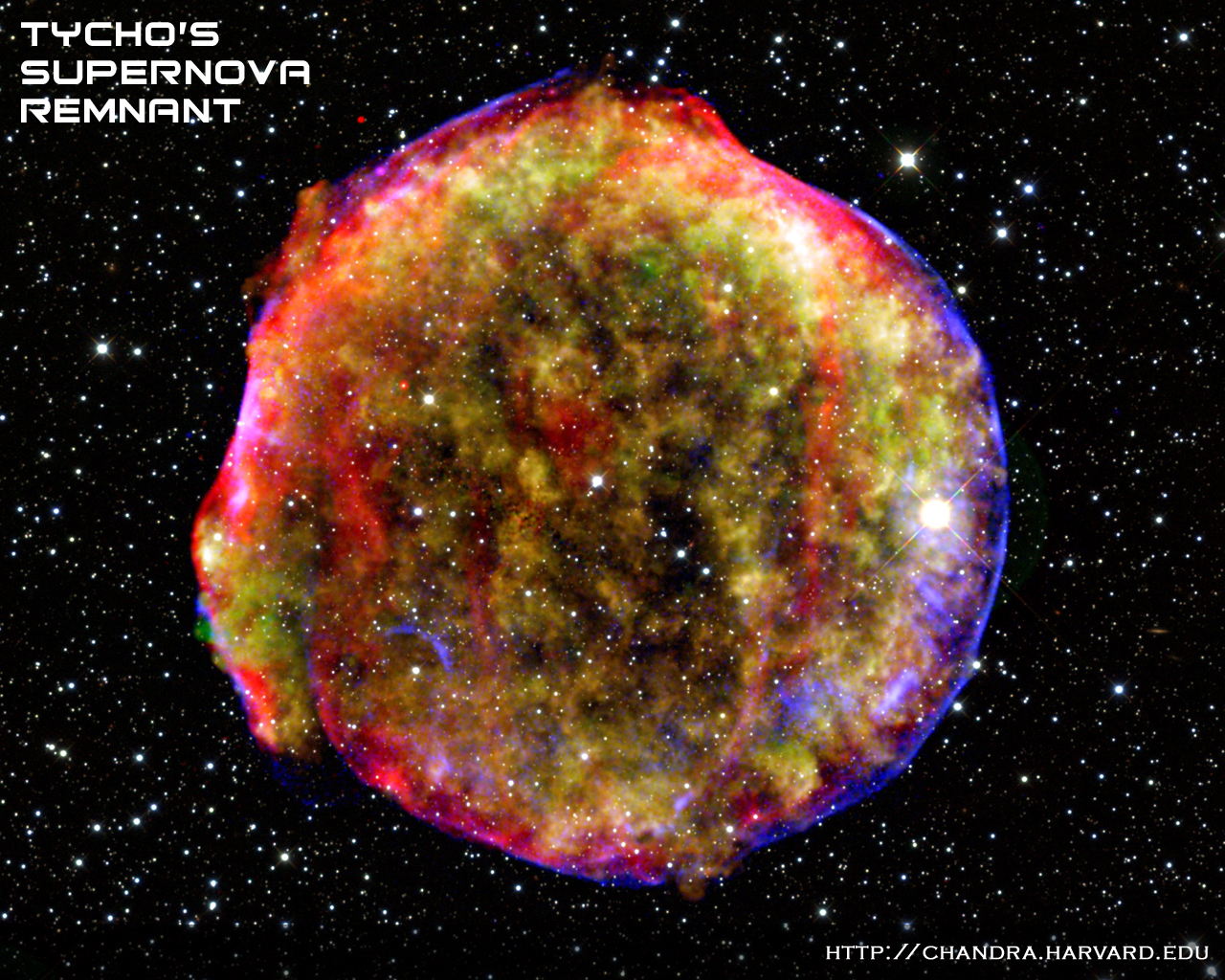
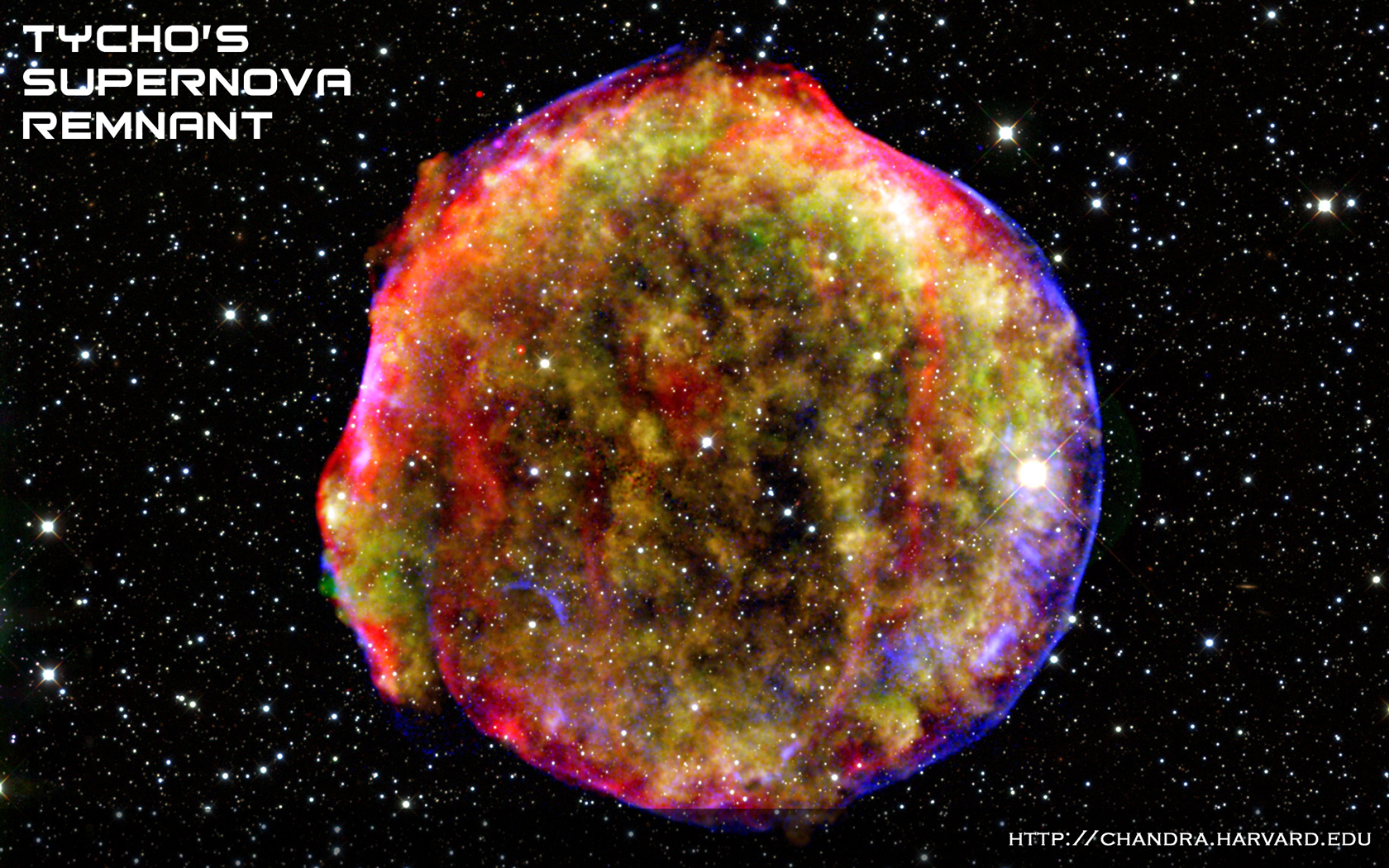
This composite image of the Tycho supernova remnant combines X-ray and
infrared observations obtained with NASA's Chandra X-ray Observatory and
Spitzer Space Telescope, respectively, and the Calar Alto observatory,
Spain. It shows the scene more than four centuries after the brilliant star
explosion witnessed by Tycho Brahe and other astronomers of that era.
The explosion has left a blazing hot cloud of expanding debris (green and
yellow) visible in X-rays. The location of ultra-energetic electrons in the
blast's outer shock wave can also be seen in X-rays (the circular blue
line). Newly synthesized dust in the ejected material and heated
pre-existing dust from the area around the supernova radiate at infrared
wavelengths of 24 microns (red). Foreground and background stars in the
image are white.
Oliver Krause, from the Max Planck Institute for Astronomy in Germany,
recently studied reflected light from the supernova explosion seen by
Brahe. Use of these "light echoes" - not shown in this figure - has
confirmed previous suspicions that the explosion was a Type Ia
supernova. This type of supernova is generally believed to be caused by the
explosion of a white dwarf star in a binary star system.
| Fast Facts for Tycho's Supernova Remnant: |
| Credit |
X-ray: NASA/CXC/SAO, Infrared: NASA/JPL-Caltech; Optical: MPIA, Calar Alto, O.Krause et al. |
| Release Date |
February 18, 2009 |
| Scale |
Image is 15.5 arcmin across. |
| Category |
Supernovas & Supernova Remnants |
| Coordinates (J2000) |
RA 00h 25m 17s | Dec +64° 08' 37" |
| Constellation |
Cassiopeia |
| Observation Date |
29 Apr 2003
|
| Observation Time |
41 hours |
| Obs. ID |
3837
|
| Instrument |
ACIS
|
| Also Known As | G120.1+01.4, SN 1572 |
| Color Code |
X-ray: Yellow, Green, Blue; Infrared: Red; Optical: White stars |
| Distance Estimate |
About 13,000 light years
|
|