

Massive Stars (con't.)
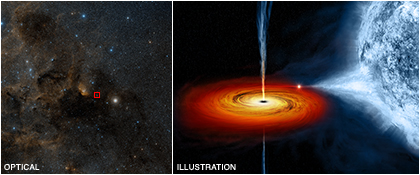
Cygnus X-1 is located near large active regions of star formation in the Milky Way, as seen in the optical image to the right that spans ~700 light years across. The artist’s illustration next to the image depicts what astronomers think might be happening within the Cygnus X-1 system. Cygnus X-1 is a 15 stellar mass black hole formed from the collapse of a massive star in a Type II supernova event. The black hole accretes material from its massive, blue companion star and the material forms a disk that rotates around the black hole before falling into it or being redirected away from the black hole in the form of powerful jets perpendicular to the spin axis of Cygnus X-1. The system is ~6070 light years from Earth and formed ~6 million years ago.
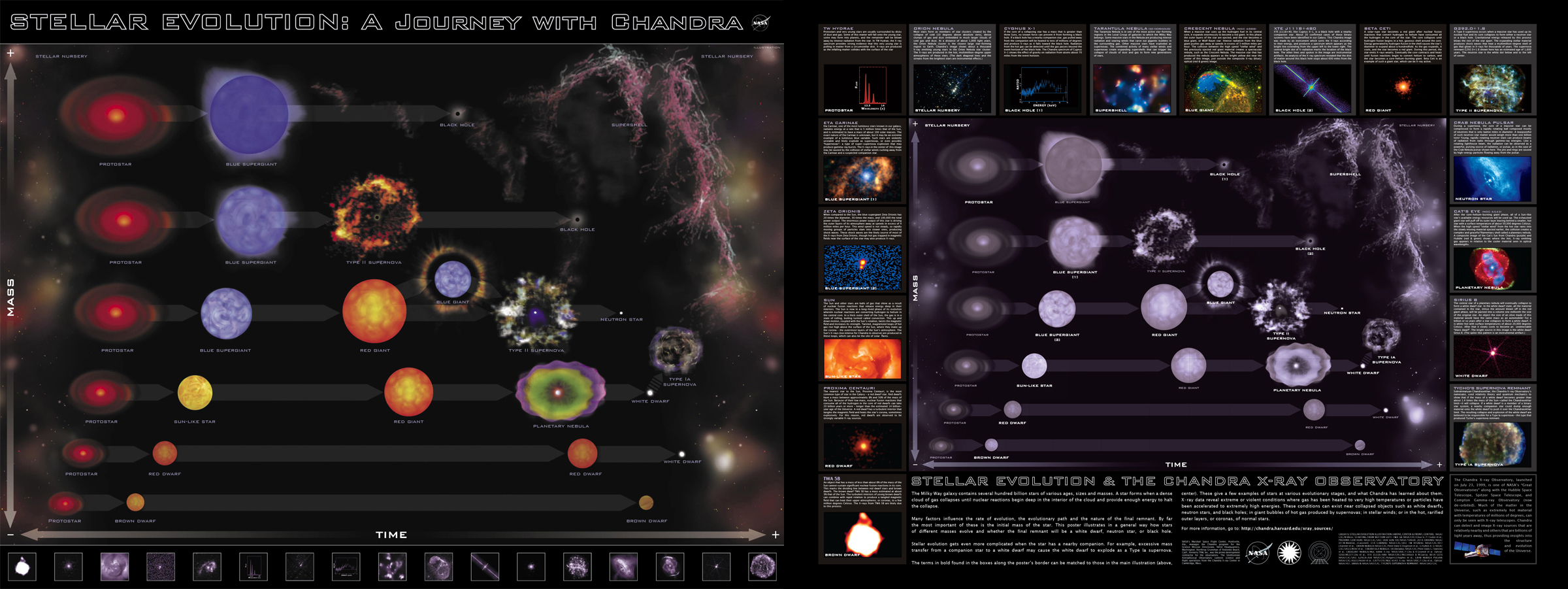
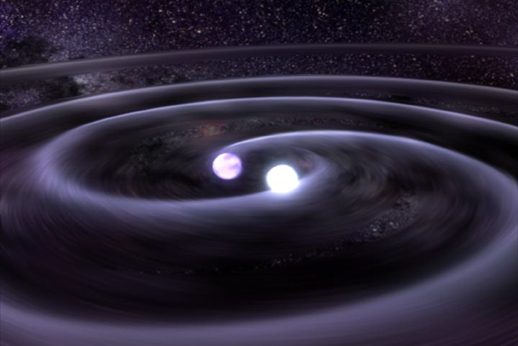
This has been a brief introduction to stellar evolution – the process during which stars undergo a sequence of radical changes from formation to destruction and final end products. Stellar evolution is a complex process and not well understood. The sequences presented for low, mid-sized and massive stars are not the only evolutionary sequences – and some of the end products can be formed during different circumstances. For example, the core collapse of a massive star is not the only process that can produce a neutron star. Two white dwarfs in a binary system can coalesce into a neutron star if the total mass does not exceed 2.4 solar masses. RX J0806.3+1527 (or J0806) is a binary star system comprised of two white dwarfs orbiting each other ~every 5 minutes. The orbital system is decreasing by 1.2 milliseconds/year and therefore moving closer to each other by .61 meters/day. If the total mass of the two white dwarfs exceeded 2.4 solar masses – the limit at which neutron degeneracy pressure can hold a stellar core in equilibrium with gravity – the end result would be a Type Ia supernova event. If the combined mass exceeded 1.4 solar masses, but less than 2.4 solar masses, they would coalesce into a neutron star. However, it is estimated that the J0806 system white dwarfs are each approximately 0.5 solar masses – in which case they would coalesce into a larger white dwarf.
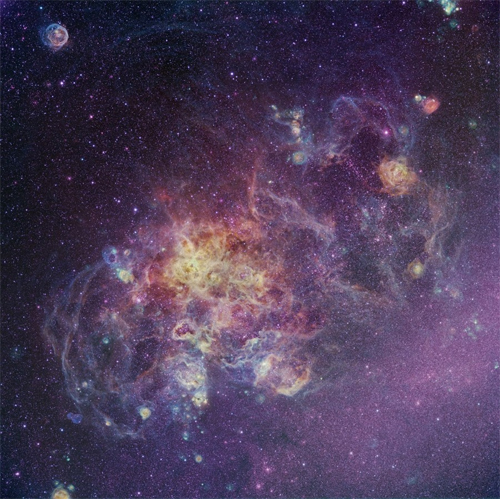
Scientists are just beginning to construct the knowledge necessary to understand the complexities of stellar evolution. Ground-based and orbiting spacecraft are imaging stars in all stages of evolution with the entire electromagnetic spectrum – radio through gamma rays. Images, like the image of the Tarantula Nebula shown here, give us extraordinary views of stellar evolution - from protostars just emerging from their stellar cocoons to thermonuclear fusion in massive hot, blue stars, to supernovae remnants that result from catastrophic collapses or thermonuclear explosions that create the elements for the next generation of protostars and stars. Somehow, within this maelstrom of turbulence, intense radiation and ferocious stellar winds, stars and planetary systems – and even life - form. Technological advances are allowing us to explore the universe in unprecedented detail, and each observation brings new knowledge and discoveries.




Revised: June 13, 2019