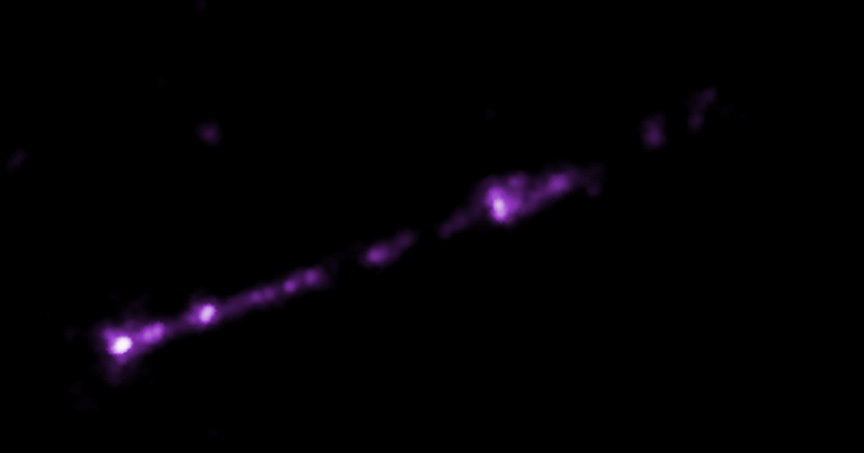

Astronomers have produced the most detailed X-ray views ever obtained of the jet launched from the supermassive black hole at the center of Messier (M87), as reported in a press release from Laval University in Canada. The main video from NASA’s Chandra X-ray Observatory (purple) showing X-ray images taken in 2012, 2017, 2023 and 2025. Using advanced image-processing techniques, researchers have tracked the evolution of the jet structures in remarkable detail.
Messier 87 is located about 55 million light-years from Earth and has one of the largest known black holes — weighing some 6.5 billion times the mass of the Sun — in its core. This black hole was the first ever to have a direct image taken of it, by the Event Horizon Telescope and released in 2019. Prior to that, M87 was already very well known among astronomers for many reasons — including the spectacular jet that blasts away from the black hole.
Until now, X-ray observations could not resolve some jet structures as clearly as observations obtained at other wavelengths, particularly in the radio and optical bands. Using an image-processing technique known as deconvolution, the Chandra images of the jet now reveal much finer details, achieving an X-ray resolution comparable to that reached at other wavelengths.
The researchers identified several substructures that appear to move at apparent speeds approaching five times the speed of light. This phenomenon, known as superluminal motion, is an optical illusion produced when particles travel at speeds close to that of light and in a direction roughly toward Earth. The team also observed significant brightness variations in several regions of the jet. These changes are consistent with a process known as synchrotron cooling, which occurs when highly energetic particles lose energy while interacting with magnetic fields.
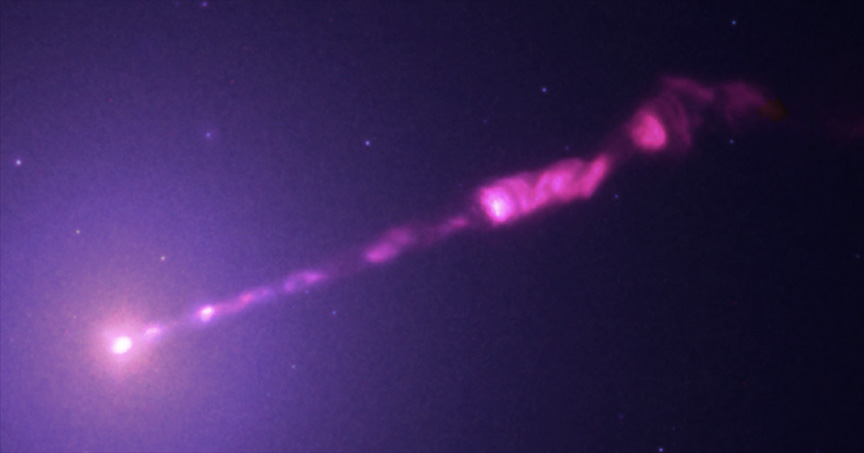
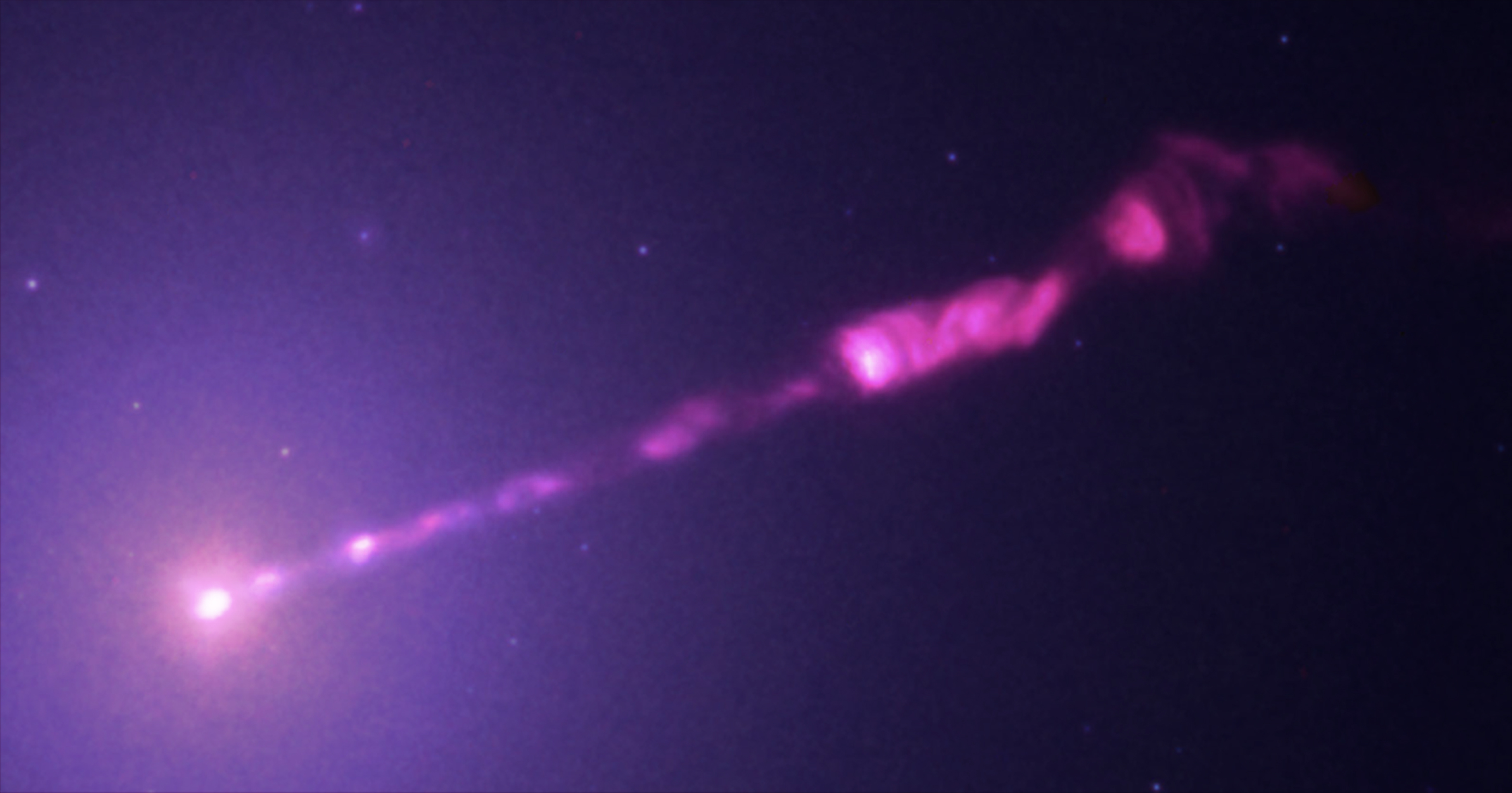
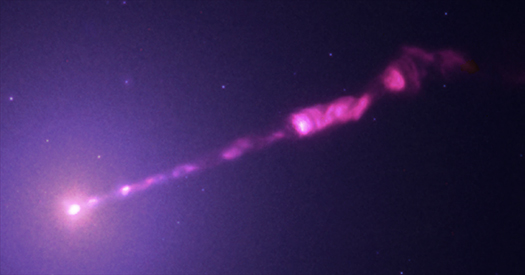
A composite image shows the data from NASA’s Chandra X-ray Observatory (purple) that have been combined with infrared (light blue, magenta, and white) from NASA’s James Webb Space Telescope, optical (magenta) data from NASA’s Hubble Space Telescope, and radio data from the NSF’s Very Large Array (blue).
These results were presented at the 248th meeting of the American Astronomical Meeting in Pasadena, CA, by Camille Poitras (Laval University in Canada). NASA's Marshall Space Flight Center in Huntsville, Alabama, manages the Chandra program. The Smithsonian Astrophysical Observatory's Chandra X-ray Center controls science operations from Cambridge, Massachusetts, and flight operations from Burlington, Massachusetts
This astronomical composite image shows a highly detailed, textured jet erupting diagonally across a dark blue, starry background from the brilliant white-pink core of the galaxy M87 in the lower-left corner toward the upper-right. The jet is color-coded in shades of vibrant pink, magenta, and deep purple — representing combined data from the Chandra (X-ray), Hubble (optical), Webb (infrared), and VLA (radio) telescopes. The jet appears not as a smooth stream, but as a turbulent, twisting chain of highly defined, glowing knots and ripples that gradually widen and diffuse into wispy clouds at its outer edge.
This timelapse sequence presents a series of NASA Chandra X-ray Observatory images of the jet from the supermassive black hole at the center of the galaxy M87. Rendered in shades of purple against a black background, the video reveals subtle but measurable changes in the jet's structure over more than a decade of observations. Bright knots and filamentary features appear to shift outward from the galaxy's core, tracing streams of extremely energetic particles launched by the black hole. As the frames progress, variations in brightness and position become apparent, highlighting the jet's dynamic nature and allowing astronomers to track its evolution over time.
|
||||||||||||||||||||||||||||||||

| Share This |


|